Nanoparticles: synthesis and applications
| Institution | UNIVERSITY |
| Course | BACHELOR OF SCIENCE... |
| Year | 4th Year |
| Semester | Unknown |
| Posted By | stephen oyake rabilo |
| File Type | |
| Pages | 30 Pages |
| File Size | 1.73 MB |
| Views | 6391 |
| Downloads | 0 |
| Price: |
Buy Now
 Buy via
whatsapp Buy via
whatsapp
|


Description
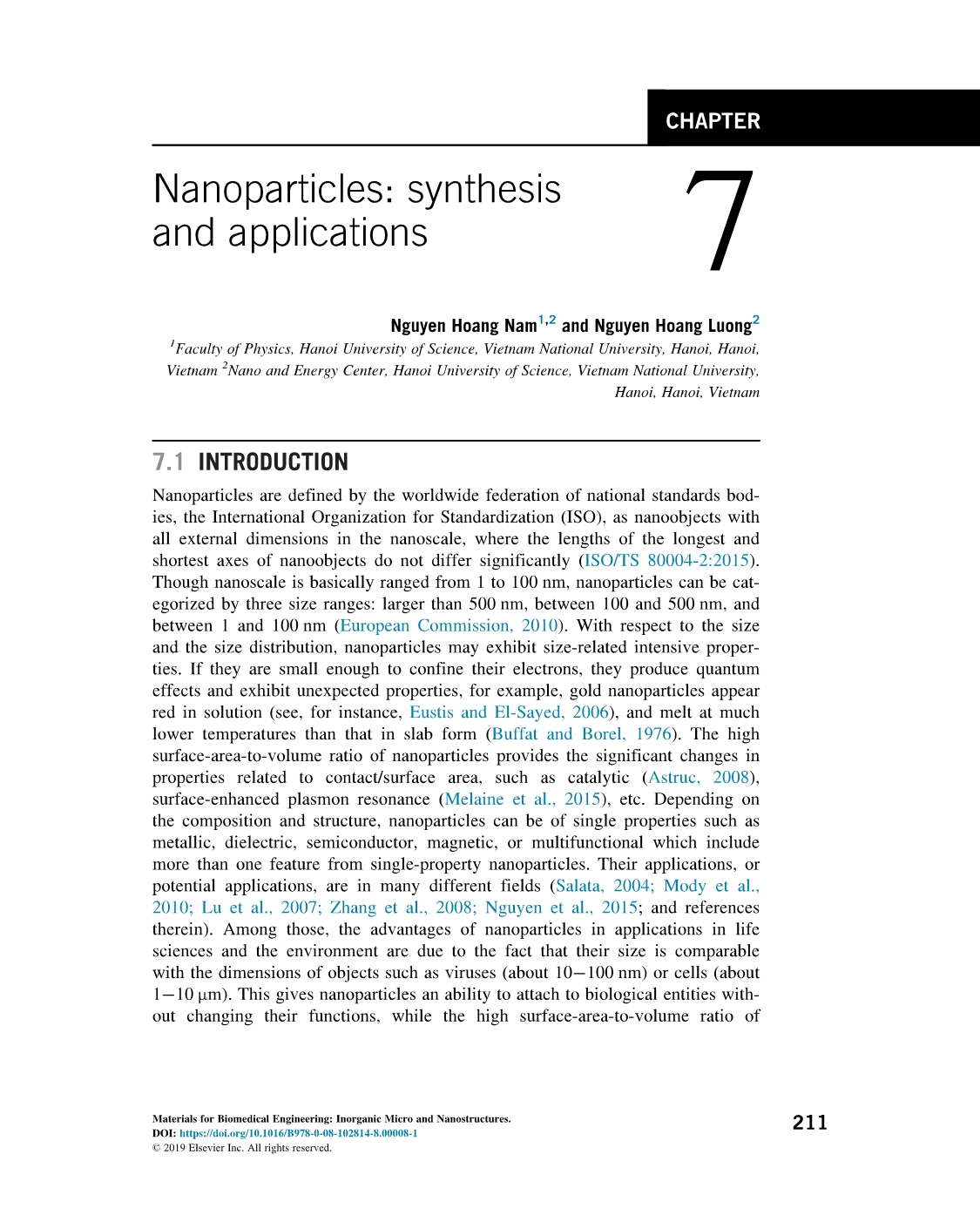
Nanoparticles are defined by the worldwide federation of national standards bodies, the International Organization for Standardization (ISO), as nanoobjects with
all external dimensions in the nanoscale, where the lengths of the longest andshortest axes of nanoobjects do not differ significantly . Though nanoscale is basically ranged from 1 to 100 nm, nanoparticles can be categorized by three size ranges: larger than 500 nm, between 100 and 500 nm, and
between 1 and 100 nm (European Commission, 2010). With respect to the size and the size distribution, nanoparticles may exhibit size-related intensive properties. If they are small enough to confine their electrons, they produce quantum effects and exhibit unexpected properties, for example, gold nanoparticles appear red in solution (see, for instance, Eustis and El-Sayed, 2006), and melt at much lower temperatures than that in slab form (Buffat and Borel, 1976). The high surface-area-to-volume ratio of nanoparticles provides the significant changes in properties related to contact/surface area, such as catalytic (Astruc, 2008),surface-enhanced plasmon resonance (Melaine et al., 2015), etc.
Below is the document preview.

SMA 2104: Mathematics for Sciences - Lesson 9 TRIGONOMETRY
Trending!
Upon completing this topic, you should be able to Define, manipulate and apply trigonometric functions. Define the basic trigonometric ratios, sine, cosine and tangent of an angle and derive the other trigonometric ratios; cosecant, secant and cotangent using the basic trigonometric ratios. Derive identities involving the trigonometric ratios
11 Pages
9992 Views
0 Downloads
635.34 KB
SMA 2104: Quadratic Equations Practice Problems
Trending!
Quadratic Equations Practice Problems, Solving Quadratic Equations When the Product of Two Numbers is Zero
12 Pages
8816 Views
0 Downloads
602.99 KB
SMA 2104: Factorisation Practice Questions
Get a copy Factorisation Practice Questions, this is suitable for your revision
2 Pages
571 Views
0 Downloads
38.59 KB
SMA 2104: Factorisation Practice Questions Answers
Trending!
Factorisation Practice Questions Answers
2 Pages
9746 Views
0 Downloads
38.59 KB
EEE 2202: ANALOGUE ELECTRONICS I
Trending!
Electronics is the study of conduction current in solids, gases, vacuum and liquids.
It is a branch of engineering that comes from the 2 words Electrons - negatively charged particle in an atom, Mechanics - Study of motion of an electron. Electronics is also study of electrons and how they can be used to perform different functions.
The ability to control movement of electrons or electron flow is the basic of electronics it specializes in digital computers, audio systems, communication systems, and automatic control.
99 Pages
8733 Views
0 Downloads
1.43 MB
HBC 2101: Introduction to Accounting I - Course Outline
Trending!
Introduce students to financial accounting for processing and communicating of financial information to support economic decision making. This particularly focuses on procedures of book keeping and preparation of the financial statements for a simple business.
1 Pages
9138 Views
0 Downloads
51.57 KB
HBC 2101: Introduction to Accounting I - ERRORS ON ACCOUNTS
Trending!
The trial balance produced from the accounts appears to be correct, i.e the debits
are the same as the credits. However, on taking a close check on the balances and
transactions posted, errors may have been made and therefore the balances shown on
the trial balance may be incorrect i.e. under or over stated.
16 Pages
8565 Views
0 Downloads
331.19 KB
HBC 2101: Introduction to Accounting I
Accounting is defined as a process of Recording Classifying Summarizing Interpreting the financial transactions and Communicating the result thereof to the persons interested in such information for decision making purposes
48 Pages
546 Views
0 Downloads
1.25 MB
HBC 2101: Nature, purpose and scope of accounting
Trending!
Accounting may be defined as the process of collecting, recording, summarizing and
communicating financial information. Accounting is nothing but a means of
communicating the results of business operations to varies parties interested in or
connected with the business, viz., the owner, creditors, investors, government, financial institutions and other agencies. Accounting is, therefore, rightly called as the language of business. The basis purpose of a language is to serve as a means of communication. Accounting also serve this purpose. Accounting is not only associated with business but also with every body who is interested in keeping an account for the money received and money spent.
10 Pages
8928 Views
0 Downloads
110.52 KB
HBC 2101: Purchases Ledger Control Account.
Trending!
Purchases Ledger Control Account is a summary account which checks the arithmetical accuracy of the Purchases Ledger. It enables us to see at a glance whether the general ledger balance for the purchase’s ledger agrees with the total of all the individual trade payable accounts held within the purchase’s ledger.
3 Pages
8922 Views
0 Downloads
84.66 KB