Nanoparticles: synthesis and applications
| Institution | UNIVERSITY |
| Course | BACHELOR OF SCIENCE... |
| Year | 4th Year |
| Semester | Unknown |
| Posted By | stephen oyake rabilo |
| File Type | |
| Pages | 30 Pages |
| File Size | 1.73 MB |
| Views | 5551 |
| Downloads | 0 |
| Price: |
Buy Now
 Buy via
whatsapp Buy via
whatsapp
|


Description
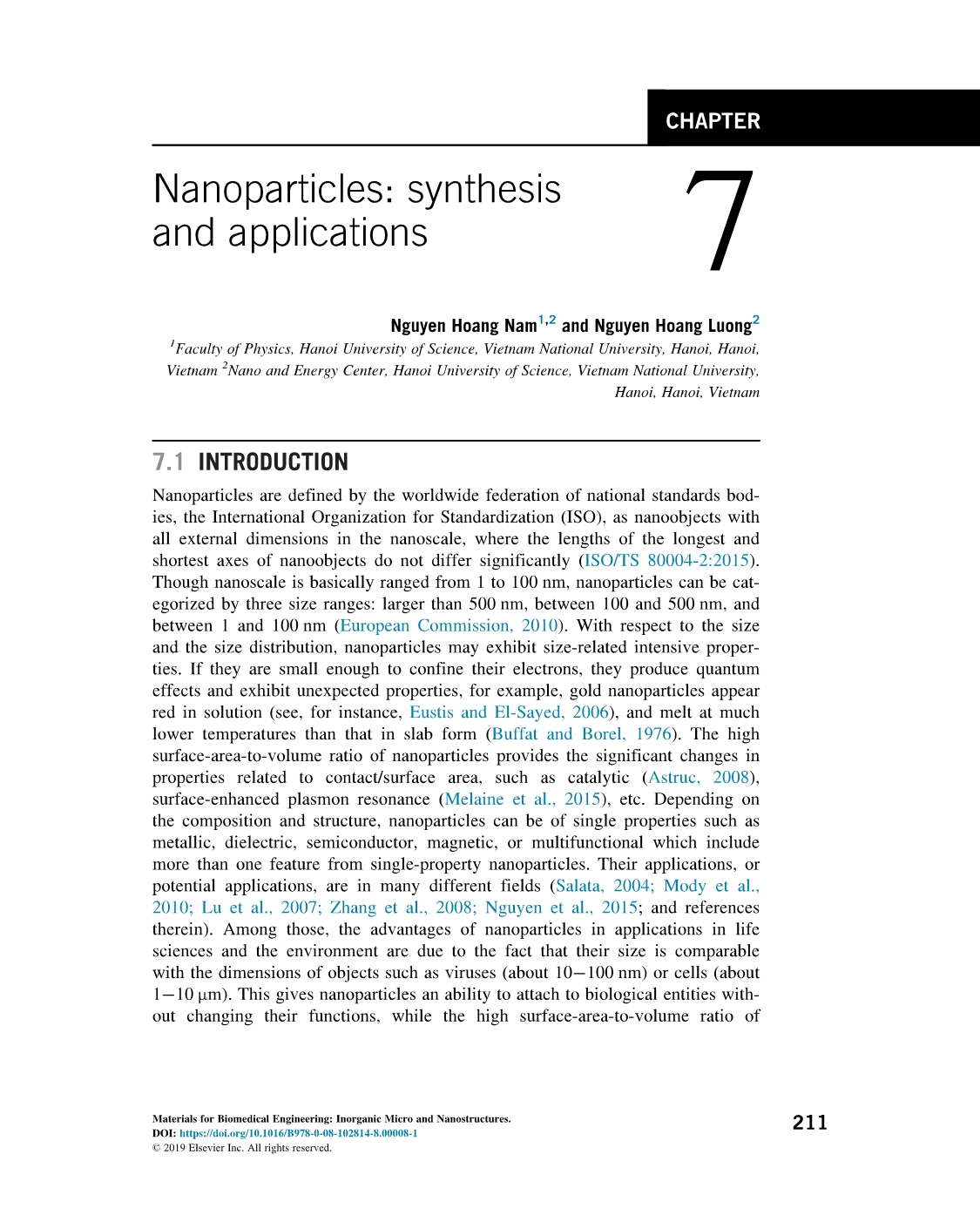
Nanoparticles are defined by the worldwide federation of national standards bodies, the International Organization for Standardization (ISO), as nanoobjects with
all external dimensions in the nanoscale, where the lengths of the longest andshortest axes of nanoobjects do not differ significantly . Though nanoscale is basically ranged from 1 to 100 nm, nanoparticles can be categorized by three size ranges: larger than 500 nm, between 100 and 500 nm, and
between 1 and 100 nm (European Commission, 2010). With respect to the size and the size distribution, nanoparticles may exhibit size-related intensive properties. If they are small enough to confine their electrons, they produce quantum effects and exhibit unexpected properties, for example, gold nanoparticles appear red in solution (see, for instance, Eustis and El-Sayed, 2006), and melt at much lower temperatures than that in slab form (Buffat and Borel, 1976). The high surface-area-to-volume ratio of nanoparticles provides the significant changes in properties related to contact/surface area, such as catalytic (Astruc, 2008),surface-enhanced plasmon resonance (Melaine et al., 2015), etc.
Below is the document preview.

CIFA SEC 4: Equity Investment Analysis
Trending!
This paper is intended to equip the candidate with the knowledge, skills and attitude that will enable him/her to value and analyze equity investments.
316 Pages
8111 Views
3 Downloads
6.49 MB
Financial Accounting Q&A Revision Kit
Trending!
Download a copy of the Financial Accounting Q&A Revision Kit, The booklet contains Questions from past papers and their Comprehensive Answers. This revision partner will be ideal in your assignments and exam preparations.
168 Pages
8945 Views
0 Downloads
646.15 KB
OPERATIONS RESEARCH NOTES
Trending!
Operations Research has gained wider acclaim in the modern complex business world. For every complex problem of an industry today, well defined Operations Research tools are the solace.
308 Pages
5768 Views
0 Downloads
3.7 MB
Equity Investments Analysis Revision Kit
Trending!
Download a copy of the Equity Investments Analysis Revision Kit, The booklet contains Questions from past papers and their Comprehensive Answers. This revision partner will be ideal in your assignments and exam preparations.
77 Pages
7733 Views
2 Downloads
48.67 MB
Financial Mathematics Past Papers
Grab a copy of Financial Mathematics past papers for purposes of your exam preparations and practice.
38 Pages
583 Views
0 Downloads
1.64 MB
MANAGEMENT INFORMATION SYSTEMS NOTES
Trending!
Management Information System is an old management tool, which has been long used by people for better management and scientific decision-making.
272 Pages
6883 Views
0 Downloads
3.04 MB
CONSUMER BEHAVIOUR NOTES
Trending!
Consumer behavior is a rapidly growing discipline of study. It means more than just how a person buys products.
208 Pages
5837 Views
0 Downloads
6.28 MB
SALES AND PROMOTIONS MANAGEMENT NOTES
Before the industrial revolution the marketing task was relatively simple because the economic scene was dominated by small scale enterprises. The only problem was to produce goods for consumers which were sold out without any difficulty.
164 Pages
290 Views
0 Downloads
16.93 MB
Financial Mathematics Study Notes
Download a copy of the Financial Mathematics study kit to enable you comprehend the course unit into finer details and also help you in preparing for KASNEB examinations.
175 Pages
517 Views
0 Downloads
2.85 MB
SALES AND PROMOTIONS MANAGEMENT NOTES PART 2
Trending!
Before the industrial revolution the marketing task was relatively simple because the economic scene was dominated by small scale enterprises. The only problem was to produce goods for consumers which were sold out without any difficulty.
95 Pages
6728 Views
0 Downloads
9.68 MB