ASPECTS OF HUMAN GROWTH AND DEVELOPMENT
| Institution | TVET |
| Course | Diploma in Social Wo... |
| Year | 1st Year |
| Semester | Unknown |
| Posted By | stephen |
| File Type | |
| Pages | 3 Pages |
| File Size | 349.09 KB |
| Views | 10597 |
| Downloads | 2 |
| Price: |
Buy Now
 Buy via
whatsapp Buy via
whatsapp
|


Description
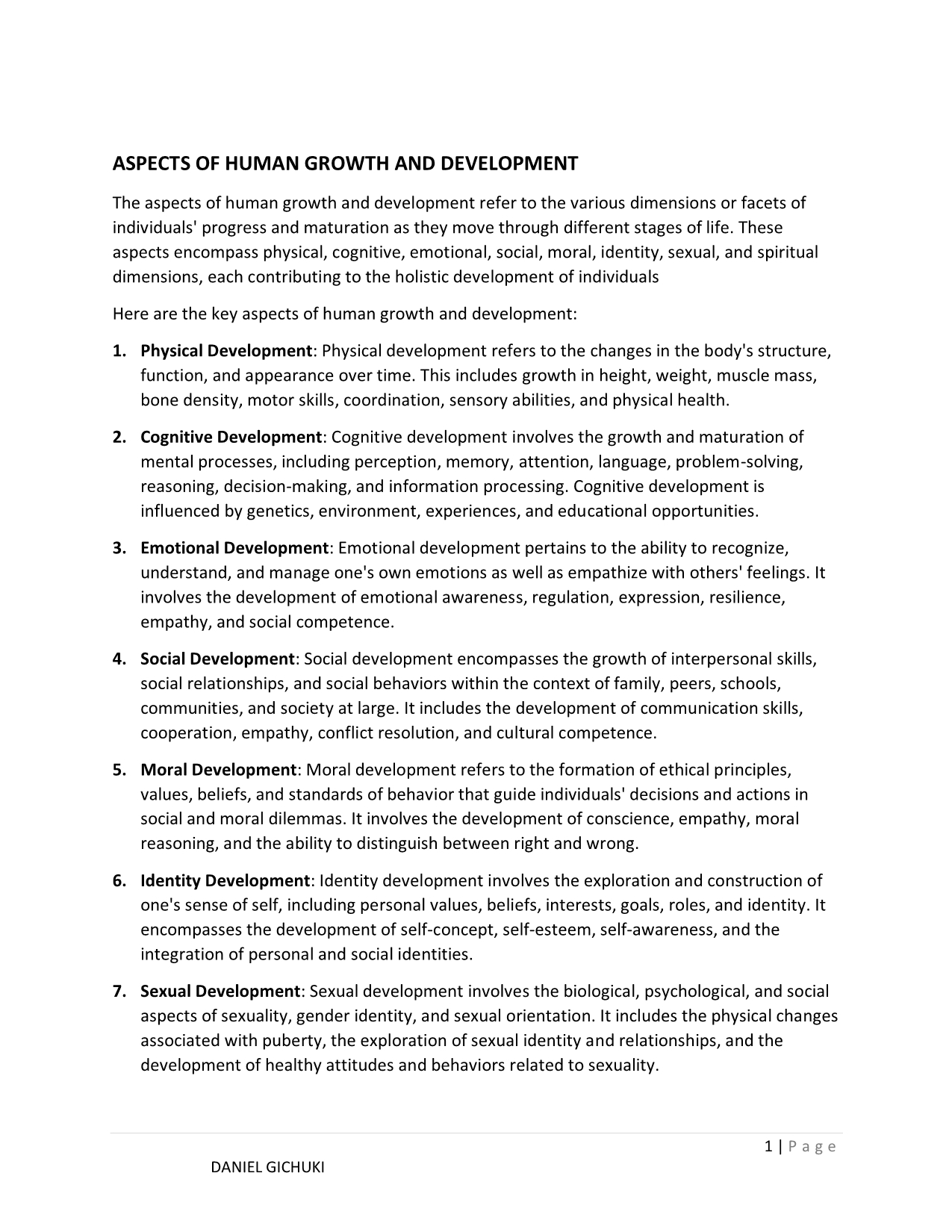
ASPECTS OF HUMAN GROWTH AND DEVELOPMENT
The aspects of human growth and development refer to the various dimensions or facets of individuals' progress and maturation as they move through different stages of life. These aspects encompass physical, cognitive, emotional, social, moral, identity, sexual, and spiritual dimensions, each contributing to the holistic development of individuals
Here are the key aspects of human growth and development:
1. Physical Development: Physical development refers to the changes in the body's structure, function, and appearance over time. This includes growth in height, weight, muscle mass, bone density, motor skills, coordination, sensory abilities, and physical health.
2. Cognitive Development: Cognitive development involves the growth and maturation of mental processes, including perception, memory, attention, language, problem-solving, reasoning, decision-making, and information processing. Cognitive development is influenced by genetics, environment, experiences, and educational opportunities.
3. Emotional Development: Emotional development pertains to the ability to recognize, understand, and manage one's own emotions as well as empathize with others' feelings. It involves the development of emotional awareness, regulation, expression, resilience, empathy, and social competence.
4. Social Development: Social development encompasses the growth of interpersonal skills, social relationships, and social behaviors within the context of family, peers, schools, communities, and society at large. It includes the development of communication skills, cooperation, empathy, conflict resolution, and cultural competence.
5. Moral Development: Moral development refers to the formation of ethical principles, values, beliefs, and standards of behavior that guide individuals' decisions and actions in social and moral dilemmas. It involves the development of conscience, empathy, moral reasoning, and the ability to distinguish between right and wrong.
6. Identity Development: Identity development involves the exploration and construction of one's sense of self, including personal values, beliefs, interests, goals, roles, and identity. It encompasses the development of self-concept, self-esteem, self-awareness, and the integration of personal and social identities.
7. Sexual Development: Sexual development involves the biological, psychological, and social aspects of sexuality, gender identity, and sexual orientation. It includes the physical changes associated with puberty, the exploration of sexual identity and relationships, and the development of healthy attitudes and behaviors related to sexuality.
Below is the document preview.

OBJECT ORIENTED PROGRAMMING NOTES
Trending!
Programming practices have evolved considerably over the past few decades. As more and more programmers gained experience problems unknown hitherto, began to surface.
357 Pages
7237 Views
0 Downloads
4.35 MB
Software Project Management Notes
Software project management includes the tools, techniques, and knowledge essential to deal with the growth of software products. In Software Project Management, the end users and developers require to know the cost of the project, duration and length. It is a process of managing, allocating and timing resources to develop computer software that meets necessities.
328 Pages
1939 Views
0 Downloads
6.37 MB
INFORMATION SECURITY AND PRIVACY NOTES
Trending!
Information System is a particular discipline or branch of learning that is concerned with the application of information to organizational needs.
241 Pages
9598 Views
0 Downloads
3.82 MB
Enterprise Resource Planning Notes
Trending!
ERP systems are now ubiquitous in large businesses and the current move by vendors is to repackage them for small to medium enterprises (SMEs).
232 Pages
5916 Views
0 Downloads
4.82 MB
CIFA: Corporate Finance Q&A Revision Kit
Trending!
Download a copy of the Corporate Finance Q&A Revision Kit, The booklet contains Questions from past papers and their Comprehensive Answers. This revision partner will be ideal in your assignments and exam preparations.
79 Pages
9776 Views
2 Downloads
63.94 MB
CIFA: Economics Revision Q&A Blocks
Trending!
Download a copy of the Economics Revision Q&A Blocks, The booklet contains Questions from past papers and their Comprehensive Answers. This revision partner will be ideal in your assignments and exam preparations.
323 Pages
9020 Views
1 Downloads
5.22 MB
CIFA/CPA: Economics Q&A Revision Kit
Trending!
Download a copy of the Economics Q&A Revision Kit, The booklet contains Questions from past papers and their Comprehensive Answers. This revision partner will be ideal in your assignments and exam preparations.
681 Pages
9305 Views
1 Downloads
4.43 MB
Entrepreneurship & Communication Skills Revision Kit
Trending!
Download a copy of the Entrepreneurship & Communication Skills Revision Kit, The booklet contains Questions from past papers and their Comprehensive Answers. This revision partner will be ideal in your assignments and exam preparations.
171 Pages
9017 Views
1 Downloads
4.11 MB
CIFA SEC 4: Equity Investment Analysis
Trending!
This paper is intended to equip the candidate with the knowledge, skills and attitude that will enable him/her to value and analyze equity investments.
316 Pages
9470 Views
4 Downloads
6.49 MB
Financial Accounting Q&A Revision Kit
Trending!
Download a copy of the Financial Accounting Q&A Revision Kit, The booklet contains Questions from past papers and their Comprehensive Answers. This revision partner will be ideal in your assignments and exam preparations.
168 Pages
10486 Views
0 Downloads
646.15 KB