BAH 3103: POSTMORTEM INSPECTION OF FOOD ANIMALS
| Institution | MOUNT KENYA UNIVERSITY |
| Course | BACHELOR IN ANIMAL H... |
| Year | 1st Year |
| Semester | Unknown |
| Posted By | stephen oyake rabilo |
| File Type | |
| Pages | 21 Pages |
| File Size | 123.1 KB |
| Views | 9709 |
| Downloads | 0 |
| Price: |
Buy Now
 Buy via
whatsapp Buy via
whatsapp
|


Description
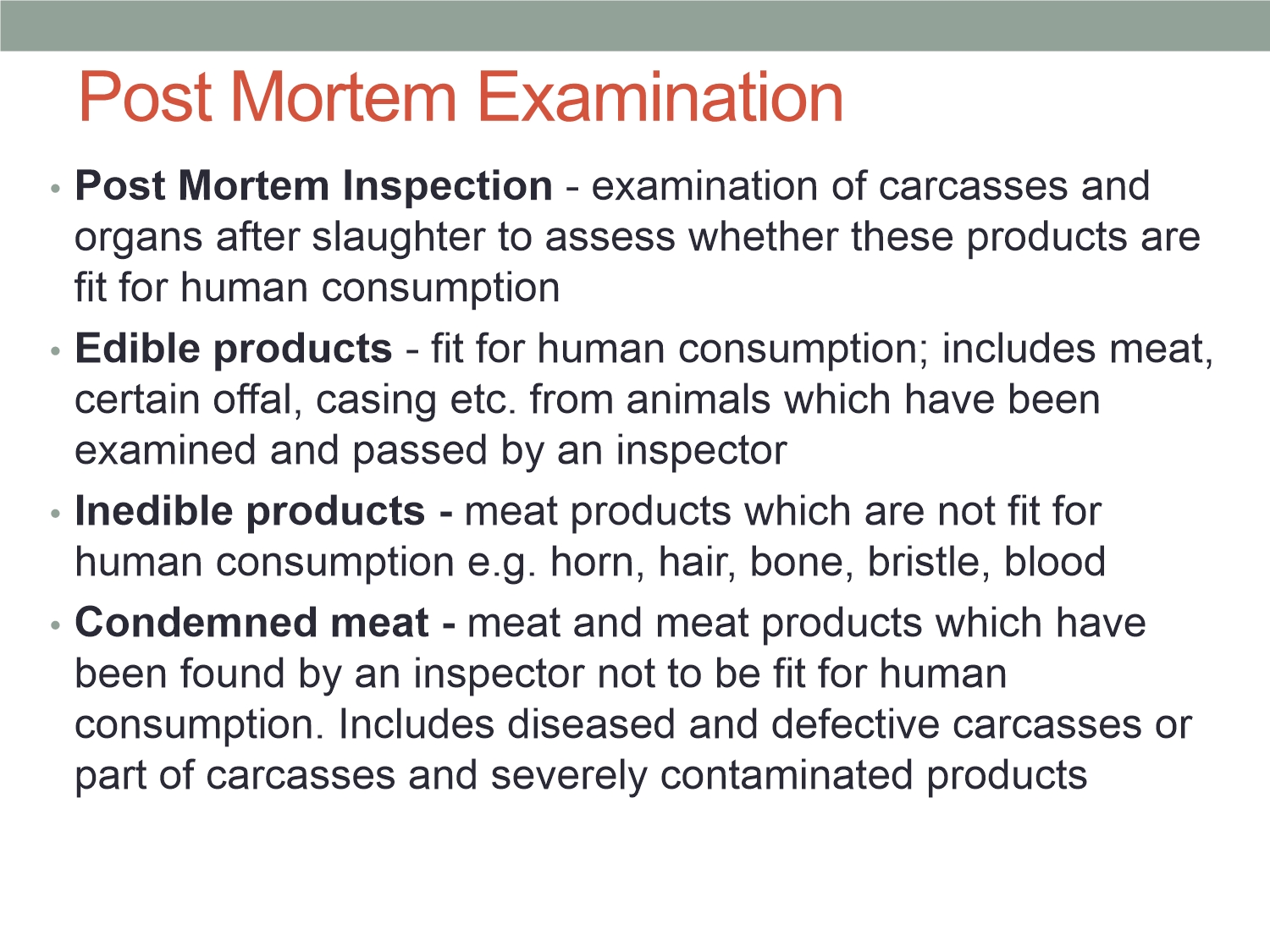
Post Mortem Examination
• Post Mortem Inspection - examination of carcasses and
organs after slaughter to assess whether these products are
fit for human consumption
• Edible products - fit for human consumption; includes meat,
certain offal, casing etc. from animals which have been
examined and passed by an inspector
• Inedible products - meat products which are not fit for
human consumption e.g. horn, hair, bone, bristle, blood
• Condemned meat - meat and meat products which have
been found by an inspector not to be fit for human
consumption. Includes diseased and defective carcasses or
part of carcasses and severely contaminated products
Below is the document preview.

INFORMATION COMMUNICATION TECHNOLOGY KNEC NOTES
Trending!
ICT (information and communications technology - or technologies) is a term that includes any communication device or application, encompassing: radio, television, cellular phones, computer and network hardware and software, satellite systems and so on, as well as the various services and applications associated with them, such as videoconferencing and distance learning.
149 Pages
9975 Views
2 Downloads
20.65 MB
CONSTRUCTION PLANT AND EQUIPMENT KNEC NOTES
Trending!
Plant refers to machinery, equipment or apparatus used for an industrial activity. In construction, plant typically refers to heavy machinery and large equipment used on construction sites – think cranes, excavators and bulldozers.
69 Pages
10100 Views
3 Downloads
3.01 MB
CONCRETE TECHNOLOGY KNEC NOTES
Trending!
Concrete is made by portland cement, water and aggregates. Portland cement is a hydraulic cement that hardens in water to form a water-resistant compound. The hydration products act as binder to hold the aggregates together to form concrete. The name portland cement comes from the fact that the colour and quality of the resulting concrete are similar to Portland stone, a kind of limestone found in England.
73 Pages
9323 Views
1 Downloads
2.42 MB
CONSTRUCTION MATERIALS KNEC NOTES
Trending!
Building material is material used for construction. Many naturally occurring substances, such as clay, rocks, sand, wood, and even twigs and leaves, have been used to construct buildings and other structures, like bridges.
69 Pages
10303 Views
2 Downloads
1.54 MB
TECHNICAL DRAWING KNEC NOTES
Trending!
Engineering depends mainly upon Engineering drawing, hence need for Engineers to acquire a good working knowledge about the subject in order to express and record the shape, size and other information necessary for the construction of various objects such as buildings, roads, bridges, machines etc.
96 Pages
9889 Views
1 Downloads
3.67 MB
WORKSHOP TECHNOLOGY MODULE 2 KNEC NOTES
Trending!
This module is to equip the trainee with the necessary knowledge, skills and attitude required to fully understand workshop tools, techniques and technology.
101 Pages
11169 Views
1 Downloads
4.15 MB
WORKSHOP TECHNOLOGY MODULE 1 KNEC NOTES
Trending!
This module 1 is to equip the trainee with the necessary knowledge, skills and attitude required to fully understand workshop tools, techniques and technology.
45 Pages
11663 Views
11 Downloads
1.3 MB
SURVEYING KNEC NOTES
Trending!
Surveying is defined as taking a general view of, by observation and
measurement determining the boundaries, size, position, quantity, condition,
value etc. of land, estates, building, farms mines etc. and finally presenting the
survey data in a suitable form. This covers the work of the valuation surveyor,
the quantity surveyor, the building surveyor, the mining surveyor and so forth, as
well as the land surveyor.
87 Pages
10113 Views
4 Downloads
1.88 MB
PHYSICAL SCIENCES KNEC NOTES
Trending!
General introduction is made to introduce the fundamentals of Chemistry and physics usually form the basis of practical in civil engineering.
50 Pages
10603 Views
7 Downloads
956.85 KB