ENERGY SOURCES
| Institution | TVET |
| Course | Certificate in ICT |
| Year | 1st Year |
| Semester | Unknown |
| Posted By | stephen oyake rabilo |
| File Type | |
| Pages | 11 Pages |
| File Size | 165.13 KB |
| Views | 8916 |
| Downloads | 0 |
| Price: |
Buy Now
 Buy via
whatsapp Buy via
whatsapp
|


Description
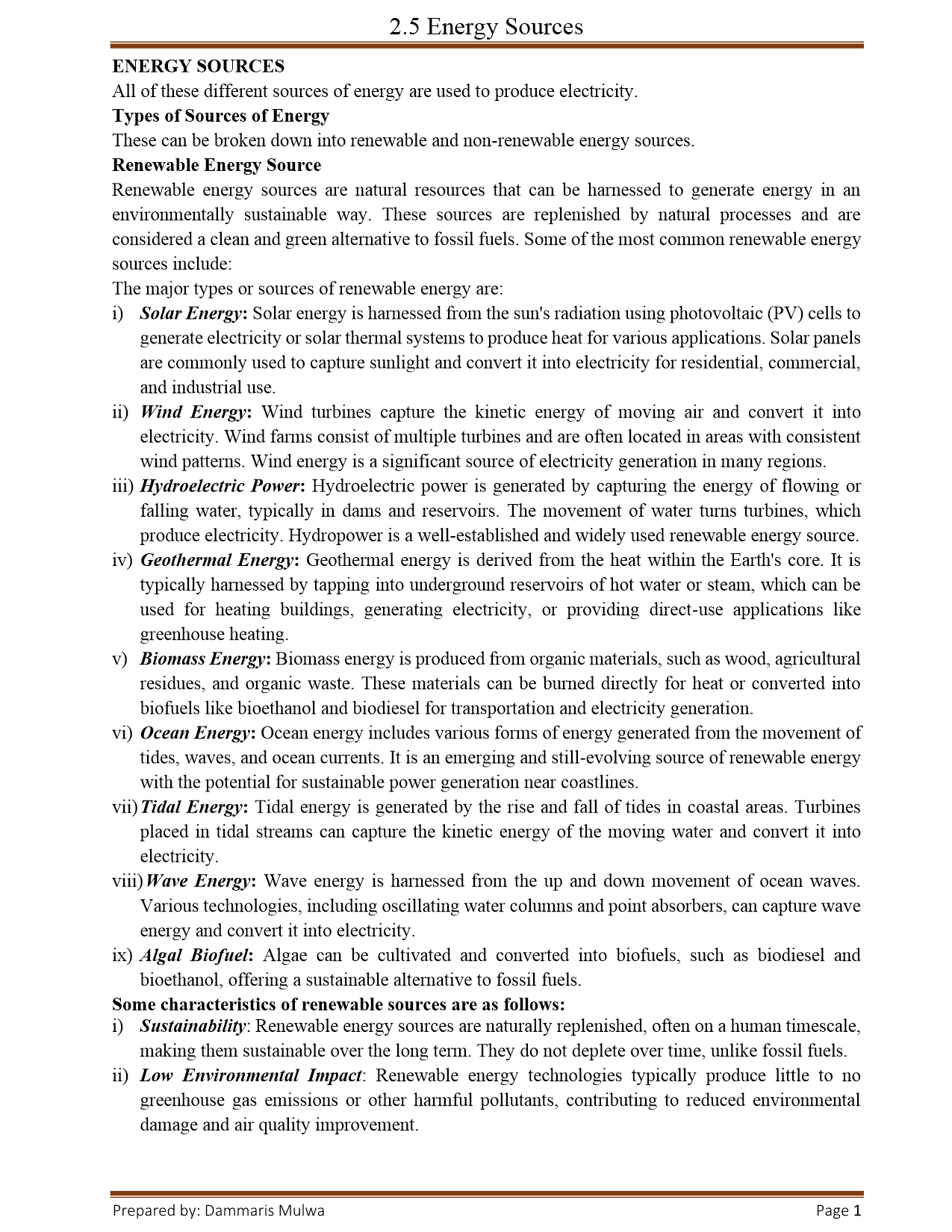
ENERGY SOURCES
All of these different sources of energy are used to produce electricity.
Types of Sources of Energy
These can be broken down into renewable and non-renewable energy sources.
Renewable Energy Source
Renewable energy sources are natural resources that can be harnessed to generate energy in an
environmentally sustainable way. These sources are replenished by natural processes and are
considered a clean and green alternative to fossil fuels. Some of the most common renewable energy
sources include:
The major types or sources of renewable energy are:
i) Solar Energy: Solar energy is harnessed from the sun's radiation using photovoltaic (PV) cells to
generate electricity or solar thermal systems to produce heat for various applications. Solar panels
are commonly used to capture sunlight and convert it into electricity for residential, commercial,
and industrial use.
ii) Wind Energy: Wind turbines capture the kinetic energy of moving air and convert it into
electricity. Wind farms consist of multiple turbines and are often located in areas with consistent
wind patterns. Wind energy is a significant source of electricity generation in many regions.
iii) Hydroelectric Power: Hydroelectric power is generated by capturing the energy of flowing or
falling water, typically in dams and reservoirs. The movement of water turns turbines, which
produce electricity. Hydropower is a well-established and widely used renewable energy source.
iv) Geothermal Energy: Geothermal energy is derived from the heat within the Earth's core. It is
typically harnessed by tapping into underground reservoirs of hot water or steam, which can be
used for heating buildings, generating electricity, or providing direct-use applications like
greenhouse heating.
v) Biomass Energy: Biomass energy is produced from organic materials, such as wood, agricultural
residues, and organic waste. These materials can be burned directly for heat or converted into
biofuels like bioethanol and biodiesel for transportation and electricity generation.
vi) Ocean Energy: Ocean energy includes various forms of energy generated from the movement of
tides, waves, and ocean currents. It is an emerging and still-evolving source of renewable energy
with the potential for sustainable power generation near coastlines.
vii)Tidal Energy: Tidal energy is generated by the rise and fall of tides in coastal areas. Turbines
placed in tidal streams can capture the kinetic energy of the moving water and convert it into
electricity.
viii)Wave Energy: Wave energy is harnessed from the up and down movement of ocean waves.
Various technologies, including oscillating water columns and point absorbers, can capture wave
energy and convert it into electricity.
ix) Algal Biofuel: Algae can be cultivated and converted into biofuels, such as biodiesel and
bioethanol, offering a sustainable alternative to fossil fuels.
Below is the document preview.

07 Ethernet Switching Basics
Trending!
Data transmission on networks must comply with certain standards. Ethernet
protocols define how data frames are transmitted over an Ethernet network.
Understanding Ethernet protocols is the basis for fully understanding
communication at the data link layer. An Ethernet switch is the main device for
implementing data link layer communication. It is essential to understand how an
Ethernet switch works.
This note describes the concepts related to Ethernet protocols, MAC address
types, and working process and mechanism of Layer 2 switches.
41 Pages
7662 Views
0 Downloads
1.24 MB
08 VLAN Principles and Configuration
Trending!
Ethernet technology implements data communication over shared media based
on carrier sense multiple access with collision detection (CSMA/CD). If there are a
large number of PCs on the Ethernet, security risks and broadcast storms may
occur, deteriorating network performance and even causing network breakdowns.
The virtual local area network (VLAN) technology is therefore introduced to solve
the preceding problem.
This note describes basic VLAN principles, working principles of different Layer 2
interfaces, VLAN applications, data forwarding principles, and basic VLAN
configuration methods.
46 Pages
8873 Views
0 Downloads
1.26 MB
09 STP Principles and Configuration
Trending!
On an Ethernet switching network, redundant links are used to implement link backup and enhance network reliability. However, the use of redundant links may produce loops, leading to broadcast storms and an unstable MAC address table. As a result, communication on the network may deteriorate or even be interrupted. To prevent loops, IEEE introduced the Spanning Tree Protocol (STP).
Devices running STP exchange STP Bridge Protocol Data Units (BPDUs) to discover loops on the network and block appropriate ports. This enables a ring topology to be trimmed into a loop-free tree topology, preventing infinite looping of packets and ensuring packet processing capabilities of devices.
IEEE introduced the Rapid Spanning Tree Protocol (RSTP) to improve the network
convergence speed.
60 Pages
9842 Views
1 Downloads
1.37 MB
10 Inter-VLAN Communication
Trending!
By default, a Layer 2 switching network is a broadcast domain, which brings many
problems. Virtual local area network (VLAN) technology isolates such broadcast
domains, preventing users in different VLANs from communicating with each
other. However, such users sometimes need to communicate.
This course describes how to implement inter-VLAN communication.
30 Pages
9424 Views
0 Downloads
1.45 MB
11. Eth-Trunk, iStack, and CSS
Trending!
As services develop and the campus network scale expands, users have
increasingly demanding requirements on network bandwidth and reliability.
Traditional solutions improve network bandwidth by upgrading devices and
implement high reliability by deploying redundant links and using the Spanning
Tree Protocol (STP), leading to low flexibility, time-consuming troubleshooting, and
complex configuration.
This chapter describes how to use Eth-Trunk, intelligent stack (iStack), and cluster
switch system (CSS) technologies to improve network bandwidth and reliability.
48 Pages
10463 Views
0 Downloads
2.23 MB
12 ACL Principles and Configuration
Trending!
Rapid network development brings challenges to network security and quality of service(QoS). Access control lists (ACLs) are closely related to network security and QoS. By accurately identifying packet flows on a network and working with other technologies, ACLs can control network access behaviors, prevent network attacks, and improve network bandwidth utilization, thereby ensuring network environment security and QoS reliability. This course describes the basic principles and functions of ACLs, types and characteristics of ACLs, basic composition of ACLs, ACL rule ID matching order, usage of wildcards, and ACL configurations.
27 Pages
9008 Views
0 Downloads
993.55 KB
13. AAA Principles and Configuration
Trending!
User management is one of the most basic security management requirements for
any network. Authentication, authorization, and accounting (AAA) is a management framework that provides a security mechanism for authorizing some users to access specified resources and recording the operations of these users. AAA is widely used because of its good scalability and easy implementation of centralized management of user information. AAA can be implemented through multiple protocols. In actual applications, the Remote Authentication Dial-In User Service (RADIUS) protocol is the most commonly used to implement AAA.
This course describes the basic concepts, implementation, basic configurations, and
typical application scenarios of AAA.
21 Pages
8407 Views
0 Downloads
869.21 KB
14 Network Address Translation
Trending!
With the development of the Internet and the increase of network applications,
limited public IPv4 addresses have become the bottleneck of network
development. To solve this problem, Network Address Translation (NAT) was
introduced.
NAT enables hosts on an internal network to access an external network. It not
only helps alleviate IPv4 address shortage but also improves the security of the
internal network as NAT prevents devices on the external network from directly
communicating with hosts on the internal network that uses private addresses.
This course describes the motivation behind NAT, and implementations and
application scenarios of different types of NAT.
32 Pages
8616 Views
0 Downloads
1.17 MB
15. Network Services and Applications
Trending!
The Internet has become an integral part of our lives, with a wide range of
applications such as file transfer, email sending, online video, web browsing, and
online gaming. Because of the layered network model, common users can use
various services provided by the application layer, without knowing technical
details such as communication technology implementations.
In previous courses, we have learned technologies related to the data link layer,
network layer, and transport layer. This chapter will describe common network
services and applications such as FTP, DHCP, and HTTP.
50 Pages
8776 Views
0 Downloads
1.7 MB
UCU110.Communication and collaboration skills
Trending!
These notes are summarizes in a manner that make your studies more simple and efficient
115 Pages
7349 Views
0 Downloads
981.5 KB