ENERGY SOURCES
| Institution | TVET |
| Course | Certificate in ICT |
| Year | 1st Year |
| Semester | Unknown |
| Posted By | stephen oyake rabilo |
| File Type | |
| Pages | 11 Pages |
| File Size | 165.13 KB |
| Views | 9369 |
| Downloads | 0 |
| Price: |
Buy Now
 Buy via
whatsapp Buy via
whatsapp
|


Description
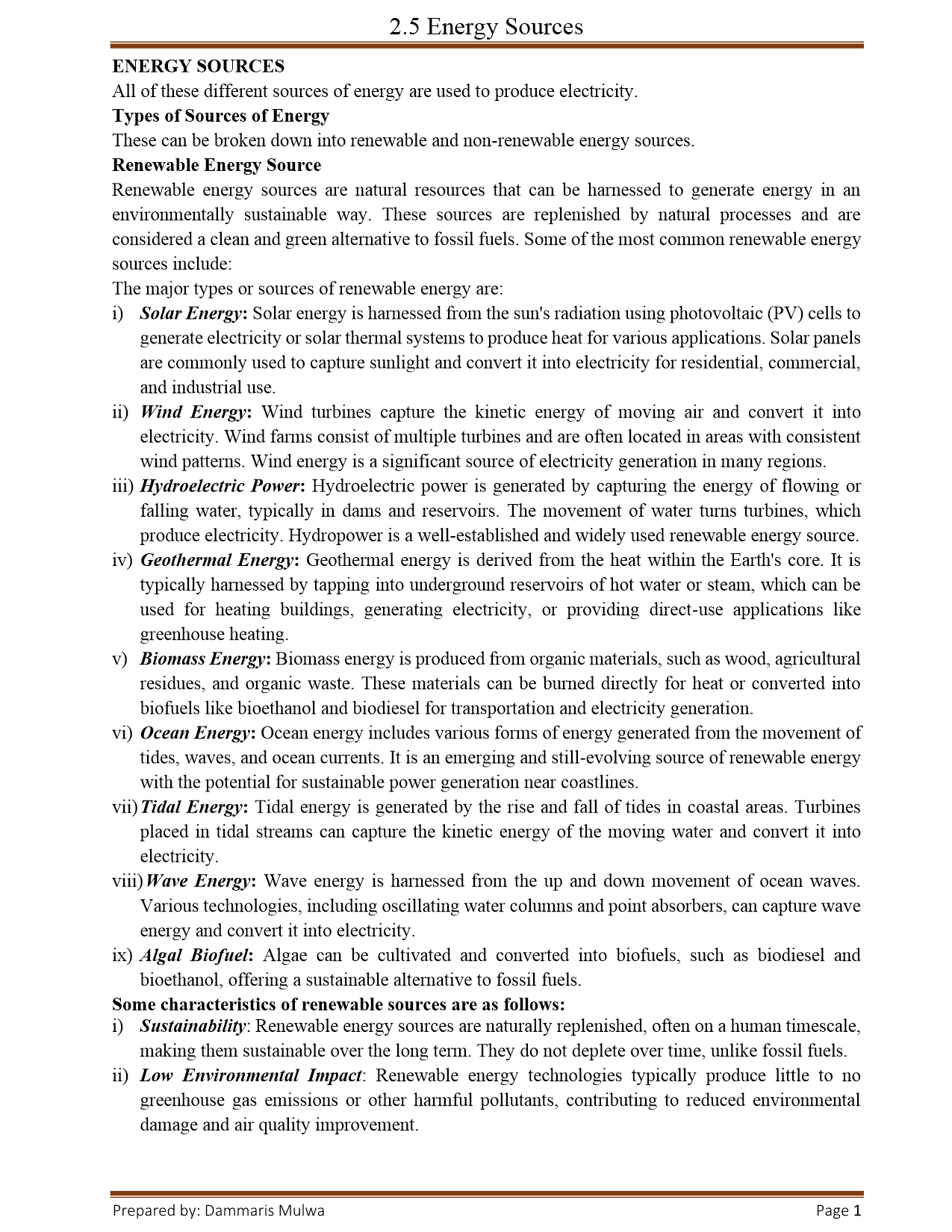
ENERGY SOURCES
All of these different sources of energy are used to produce electricity.
Types of Sources of Energy
These can be broken down into renewable and non-renewable energy sources.
Renewable Energy Source
Renewable energy sources are natural resources that can be harnessed to generate energy in an
environmentally sustainable way. These sources are replenished by natural processes and are
considered a clean and green alternative to fossil fuels. Some of the most common renewable energy
sources include:
The major types or sources of renewable energy are:
i) Solar Energy: Solar energy is harnessed from the sun's radiation using photovoltaic (PV) cells to
generate electricity or solar thermal systems to produce heat for various applications. Solar panels
are commonly used to capture sunlight and convert it into electricity for residential, commercial,
and industrial use.
ii) Wind Energy: Wind turbines capture the kinetic energy of moving air and convert it into
electricity. Wind farms consist of multiple turbines and are often located in areas with consistent
wind patterns. Wind energy is a significant source of electricity generation in many regions.
iii) Hydroelectric Power: Hydroelectric power is generated by capturing the energy of flowing or
falling water, typically in dams and reservoirs. The movement of water turns turbines, which
produce electricity. Hydropower is a well-established and widely used renewable energy source.
iv) Geothermal Energy: Geothermal energy is derived from the heat within the Earth's core. It is
typically harnessed by tapping into underground reservoirs of hot water or steam, which can be
used for heating buildings, generating electricity, or providing direct-use applications like
greenhouse heating.
v) Biomass Energy: Biomass energy is produced from organic materials, such as wood, agricultural
residues, and organic waste. These materials can be burned directly for heat or converted into
biofuels like bioethanol and biodiesel for transportation and electricity generation.
vi) Ocean Energy: Ocean energy includes various forms of energy generated from the movement of
tides, waves, and ocean currents. It is an emerging and still-evolving source of renewable energy
with the potential for sustainable power generation near coastlines.
vii)Tidal Energy: Tidal energy is generated by the rise and fall of tides in coastal areas. Turbines
placed in tidal streams can capture the kinetic energy of the moving water and convert it into
electricity.
viii)Wave Energy: Wave energy is harnessed from the up and down movement of ocean waves.
Various technologies, including oscillating water columns and point absorbers, can capture wave
energy and convert it into electricity.
ix) Algal Biofuel: Algae can be cultivated and converted into biofuels, such as biodiesel and
bioethanol, offering a sustainable alternative to fossil fuels.
Below is the document preview.

LLBK 319: CONSUMER PROTECTION ACT NO. 46 OF 2012
Trending!
Consumer Protection Act No. 46 of 2012
6524 Views
0 Downloads
895.45 KB
BASIC CONCEPTS IN INSURANCE LAW
Trending!
This is a full summary of all concepts under Insurance Law.
33 Pages
6345 Views
0 Downloads
567.67 KB
COMPUTER SYSTEMS
Computer system has three components namely: Hardware, software and liveware (computer user).
A system is a collection of different entities that collectively work together to achieve a desired goal.
Examples of systems are human body, social system, school system etc.
A computer system is a collection of three components namely hardware, software and liveware
entities that work together to receive, process, manage and present information in a meaningful
format using computers
14 Pages
309 Views
0 Downloads
707.89 KB
EEN 110: CONCEPTS IN ENVIRONMENTAL EDUCATION AND SUSTAINABLE DEVELOPMENT
Trending!
The term environment comes from a French word ‘environmer’ meaning the surrounding. It is
perceived as that part of the world with which humans interact, a sum of the total natural and
socio components which are or may be in direct interaction with humans. The environment is
also seen as a social construct made up of four dimensions; the biophysical, social, economic
and political dimensions. The environment with its dimensions form a system whose dimensions
interact affect and is affected by other dimensions. When any of the dimensions is affected
negatively or positively the entire environment is affected. Environment is a system made up of
components that interact with each other, the environment is complex system affecting the
development of humanity, and it provides resources for economic growth and for ecological and
social wellbeing.
90 Pages
8627 Views
2 Downloads
573.22 KB
LISTENING AND SPEAKING.
Trending!
In English, we have various vowel sounds. We shall study them one after the other.
Sound
Consider the letter a n the words below. Each says this sound
144 Pages
3149 Views
0 Downloads
1.81 MB
LISTENING AND SPEAKING FOR FORM FOUR
Oral poetry refers to the verbal expression of feelings, ideas and thoughts using words
arranged in their best possible order.
If sung ,it is a song
108 Pages
1689 Views
0 Downloads
1.12 MB
BIOL 244: ENVIRONMENT AND NATURAL RESOURCE MANAGEMENT
Trending!
Environment-surrounding
The surrounding conditions which
influence behaviour and development of
living things.
Environmental science therefore is the
study of the environment, its living and
non-living components and their
interactions.
273 Pages
9632 Views
0 Downloads
14.7 MB
FOND 314: FOOD SERVICE SYSTEMS
Trending!
Management is a technique of leadership or a means of coordination or cooperation. It is
systemized knowledge based on general principles which are verifiable in business practice. The
management; plans, organizes, motivates directs and controls six ‘m’ – men, money, materials,
machinery, market and minutes (time).
20 Pages
6610 Views
1 Downloads
650.95 KB
HISTORY FORM ONE
Trending!
History is the study of the past events and developments of man.
History is the study of Man’s past chronological account and record of events in
relation to his environment .Or:
162 Pages
10034 Views
0 Downloads
2.24 MB
FUNCTIONAL WRITING FORM ONE
Trending!
Sending an e-mail
-To be able to send an e-mail, you must have the e-mail address of the recipient. e.g
To: You write the address of the recipient.
From: You write the address of the sender
Cc: meaning coupon copy- other people who can be sent copies of the same mail.
Bc: a blind copy to be seen by the recipient only.
157 Pages
9085 Views
0 Downloads
1.1 MB