 Join Our WhatsApp Channel for Updates!
CPA-1-Business Law
| Institution | KASNEB |
| Course | CPA |
| Year | 1st Year |
| Semester | Unknown |
| Posted By | stephen |
| File Type | |
| Pages | 488 Pages |
| File Size | 3.14 MB |
| Views | 3451 |
| Downloads | 0 |
| Price: |
Buy Now
 Buy via
whatsapp Buy via
whatsapp
|


Description
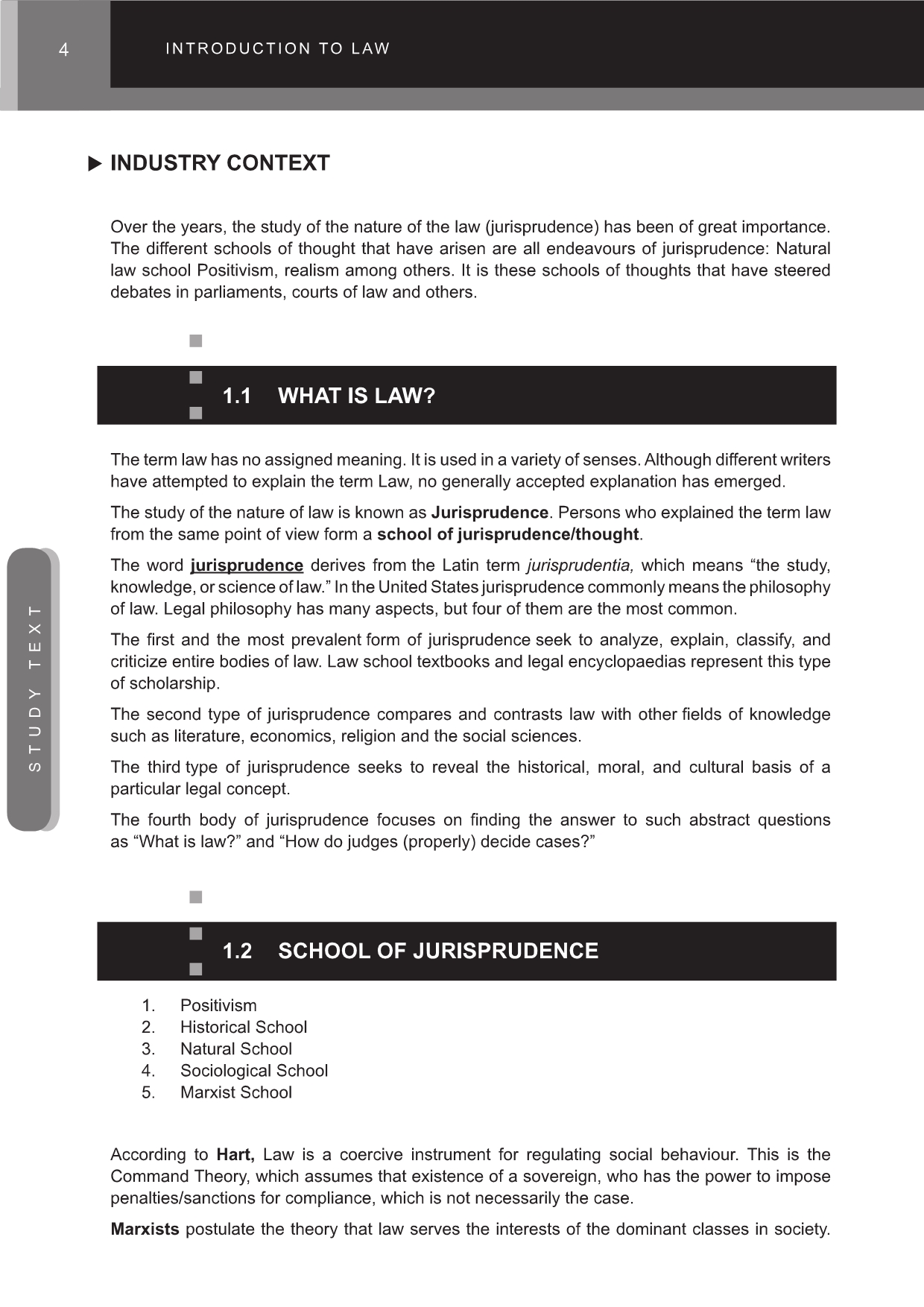
The term law has no assigned meaning. It is used in a variety of senses. Although different writers
have attempted to explain the term Law, no generally accepted explanation has emerged.
The study of the nature of law is known as Jurisprudence. Persons who explained the term law
from the same point of view form a school of jurisprudence/thought.
The word jurisprudence derives from the Latin term jurisprudentia, which means “the study,
knowledge, or science of law.” In the United States jurisprudence commonly means the philosophy
of law. Legal philosophy has many aspects, but four of them are the most common.
The first and the most prevalent form of jurisprudence seek to analyze, explain, classify, and
criticize entire bodies of law. Law school textbooks and legal encyclopaedias represent this type
of scholarship.
The second type of jurisprudence compares and contrasts law with other fields of knowledge
such as literature, economics, religion and the social sciences.
The third type of jurisprudence seeks to reveal the historical, moral, and cultural basis of a
particular legal concept.
The fourth body of jurisprudence focuses on finding the answer to such abstract questions
as “What is law?” and “How do judges (properly) decide cases?
Below is the document preview.

SPH 302 LESSON 5: Heat engines and the Carnot cycle
Trending!
A heat engine, or more simply, an engine, is a device that extracts energy from its environment in the form of heat and does useful work. At the heart of every engine is a working substance. In a steam engine, the working substance is water, in both its vapor and its liquid form. In an automobile engine, the working substance is a gasoline–air mixture. If an engine is to do work
on a sustained basis, the working substance must operate in a cycle; that is, the working substance must pass through a closed
series of thermodynamic processes, called strokes, returning again and again to each state in its cycle.
12 Pages
2706 Views
0 Downloads
464.06 KB
SPH 302 LESSON 6: Helmholtz and Gibbs free energy
Trending!
Gibbs free energy, also known as the Gibbs function, Gibbs energy, or free enthalpy, is a quantity that is used to measure the
maximum amount of work done in a thermodynamic system when the temperature and pressure are kept constant. Gibbs free
energy is denoted by the symbol ‘G’. Its value is usually expressed in Joules or Kilojoules.
8 Pages
3054 Views
1 Downloads
254.21 KB
SPH 302 LESSON 7: Thermodynamic potentials
Trending!
Thermodynamic potentials are state functions that, together with the corresponding equations of state, describe the equilibrium
behavior of a system as a function of so-called “natural variables”. The natural variables are a set of appropriate variables that
allow to compute other state functions by partial differentiation of the thermodynamic potentials.
8 Pages
3718 Views
0 Downloads
353.61 KB
SPH 302 LESSON 8: Equillibrium between phases
Trending!
The generic phase diagram of a substance in the P-T coordinates is shown in figure 8.1a and b. Every point of this diagram is an equilibrium state. Different states of the system in equilibrium are called phases. The lines dividing different phases are called the coexistence curves. Along these curves, the phases coexist in equilibrium, and the system is macroscopically inhomogeneous. All three coexistence curves can meet at the triple point.
9 Pages
3350 Views
0 Downloads
410.04 KB
UCI 301 LESSON 1: INTRODUCTION TO PROJECT MANAGEMENT
Trending!
Projects are a group of activities that have to be performed with limited resources to yield specific objectives, in a specific time, and in a specific locality. Thus, a project is a
temporary endeavor employed to create a unique product, service or results. Projects are an investment on which resources are used to create assets that will produce benefits over an expanded period of time.
2 Pages
3263 Views
0 Downloads
351.74 KB
UCI 301 LESSON 2: PROJECT LIFECYCLE
Good project management deals with three factors: time, cost and performance. Projects are successful if they are completed on time, within budget, and to performance requirements. In order to bring the many components of a large project into control there is a large toolkit of techniques, methodologies, and tools.
8 Pages
1783 Views
1 Downloads
681.69 KB
UCI 301 LESSON 3: PROJECT PLANING
Project planning defines the project activities and deliverables that will be performed and describes how the activities will be accomplished. The purpose of project planning is to define each major task, estimate the time and resources required and provided a framework management review and control.
10 Pages
1895 Views
0 Downloads
548.08 KB
UCI 301 LESSON 4: FEASIBILITY STUDY
Trending!
A feasibility study is essentially a process for determining the viability of a proposed initiative or service and providing a framework and direction for its development and delivery. It is a process for making sound decisions and setting direction.
8 Pages
2065 Views
0 Downloads
525.4 KB
UCI 301 LESSON 6: SOFTWARE COST ESTIMATION
Trending!
Estimates are made to discover the cost, to the developer, of producing a software system. You take into account, hardware, software, travel, training, overheads and effort costs. There is not a simple relationship between the development cost and the price charged to the customer.
12 Pages
2639 Views
0 Downloads
517.6 KB
UCI 301 LESSON 7: SOFTWARE CONFIGURATION MANAGEMENT
Trending!
Software configuration management is an umbrella activity that is applied throughout the software process. Because change can occur at any time, SCM activities are developed to;
1. Identify change
2. Control change
3. Ensure that change is being properly implemented
4. Report change to others who may have an interest
6 Pages
2810 Views
0 Downloads
640.34 KB