INTRODUCTION TO C++ PROGRAMMING YEAR 1
| Institution | UNIVERSITY |
| Course | BACHELOR OF SCIENCE... |
| Year | 1st Year |
| Semester | Unknown |
| Posted By | stephen oyake rabilo |
| File Type | |
| Pages | 33 Pages |
| File Size | 207.62 KB |
| Views | 6299 |
| Downloads | 0 |
| Price: |
Buy Now
 Buy via
whatsapp Buy via
whatsapp
|


Description
First Class In C++
Adapted from : http://www.cplusplus.com/doc/tutorial/tut1-1.html
Structure of a C++ program
Probably the best way to start learning a programming language is with a program. So here is our
first program:
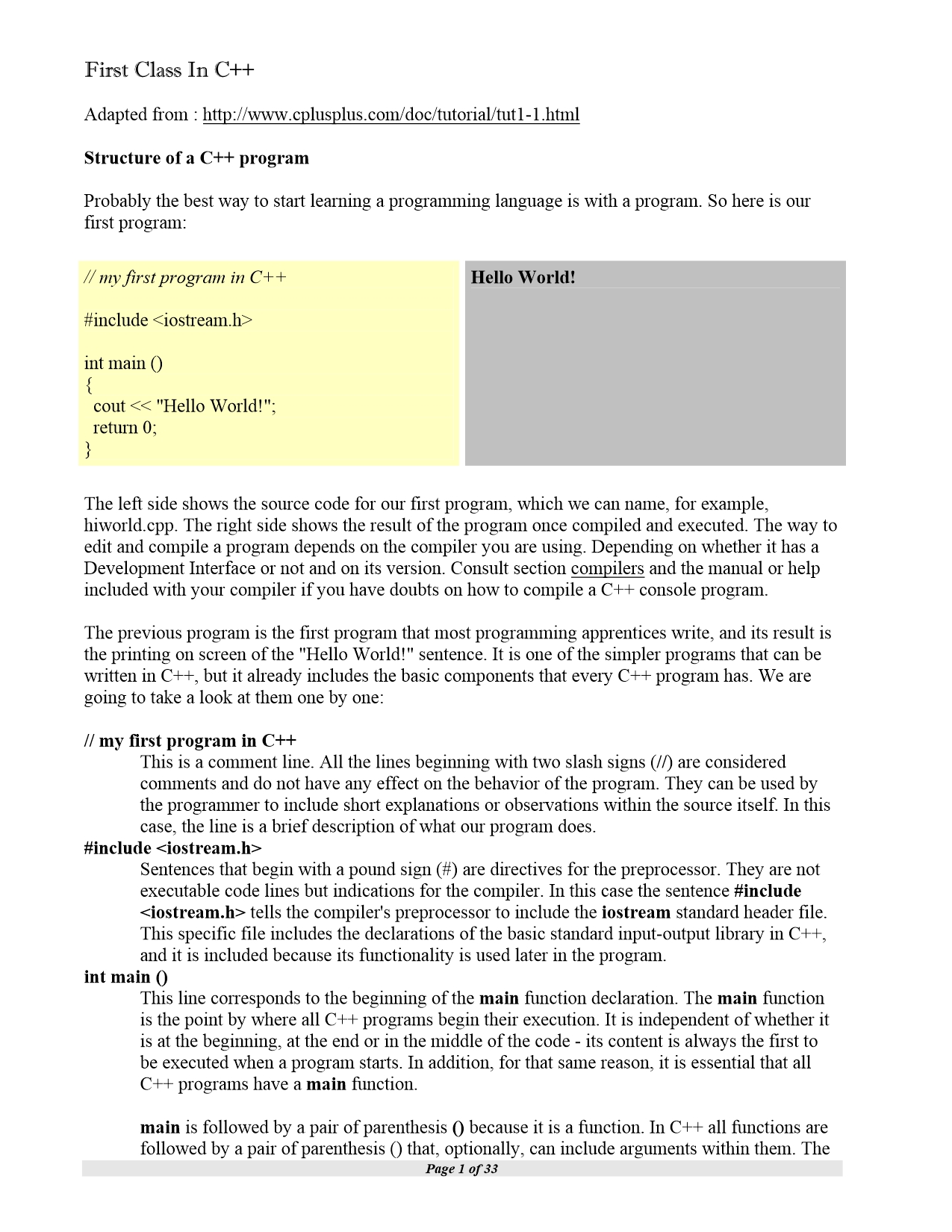
// my first program in C++
#include <iostream.h>
int main ()
{
cout << "Hello World!";
return 0;
}
Hello World!
The left side shows the source code for our first program, which we can name, for example,
hiworld.cpp. The right side shows the result of the program once compiled and executed. The way to
edit and compile a program depends on the compiler you are using. Depending on whether it has a
Development Interface or not and on its version. Consult section compilers and the manual or help
included with your compiler if you have doubts on how to compile a C++ console program.
The previous program is the first program that most programming apprentices write, and its result is
the printing on screen of the "Hello World!" sentence. It is one of the simpler programs that can be
written in C++, but it already includes the basic components that every C++ program has. We are
going to take a look at them one by one:
Below is the document preview.

Principles of Questionnaire Construction
Trending!
Rank ordering is a method that works well with a small number of objects, such as 10. For example, instead of rating how serious each of a set of organizational problems are, you could ask the respondent to simply sort them in order of most to least serious.
7369 Views
0 Downloads
23.36 KB
INTRODUCTION TO STATISTICS
Statistics is the study of how to collect, organize analyze and interpret numerical information (data).
556 Views
0 Downloads
24.68 KB
NGE 201: GEOGRAPHIC THOUGHT
Trending!
Friedrich Ratzel (1844-1904)
He dominated the geographical scene in the late 19th century. He got his early education at several universities in Germany. He travelled widely in the United States, Europe and Mexico and Worked at the Universities of Munich and Leipzig. He was trained in zoology, geology and comparative anatomy.
8753 Views
0 Downloads
59.5 KB
Writing Learning Objectives
Trending!
A learning objective answers the question: What is it that your students should be able to do at the end of the class session and course that they could not do before?
9 Pages
8182 Views
0 Downloads
111.8 KB
UCU101: Introduction to Development Studies
Trending!
Updated notes on Introduction to Development Studies
115 Pages
8726 Views
1 Downloads
4.2 MB
AGE 302: GEOGRAPHY OF AFRICA
Trending!
Geography of Africa is a unit which is developed on the knowledge that was
obtained from the study of Geography of East Africa (Age 203). This course (Age 302)
builds on the knowledge of two components namely; Physical Environment and
Human Environment.
128 Pages
3244 Views
1 Downloads
1.35 MB
AHT203: MODERN GOVERNMENTS IN AFRICA
Trending!
This module examines modern governments in Africa. These are governments
that emerged in African States in the independence and post independence period. The
module interrogates the socio-political and economic factors that have led to the growth of modern governments in Africa
67 Pages
10088 Views
2 Downloads
2.24 MB
EMP201: CURRICULUM CONTEXT
Trending!
The main purpose of education is to socialize an individual among peer groups. From the beginning of human society, the main objective of education has been that of transmitting to the child the accumulated experiences of his people and their culture as well as of training him to fit into the membership of the group. It was through this background that the society has managed to survive and gain increasing knowledge over all forms of human institutions: governance, rituals, survival etc.
9069 Views
0 Downloads
139.59 KB
HES 205: MOTOR DEVELOPMENT AND LEARNING
Trending!
This course is designed to equip the students with a framework for understanding and exploring how motor development and motor learning interact with and affect each other. The discussions in this course will encourage students to have a thorough understanding of the factors that influence and enhance the development of motor skills across the life span and approaches to teach movement skills effectively to learners at any chronological age and at any skill level
42 Pages
9111 Views
0 Downloads
1.4 MB
BAC408: APPLIED INVESTMENT
Trending!
The course covers the investment opportunities, the tools of investment analysis and performance measures.
89 Pages
7848 Views
2 Downloads
701.04 KB