INTRODUCTION TO C++ PROGRAMMING YEAR 1
| Institution | UNIVERSITY |
| Course | BACHELOR OF SCIENCE... |
| Year | 1st Year |
| Semester | Unknown |
| Posted By | stephen oyake rabilo |
| File Type | |
| Pages | 33 Pages |
| File Size | 207.62 KB |
| Views | 5378 |
| Downloads | 0 |
| Price: |
Buy Now
 Buy via
whatsapp Buy via
whatsapp
|


Description
First Class In C++
Adapted from : http://www.cplusplus.com/doc/tutorial/tut1-1.html
Structure of a C++ program
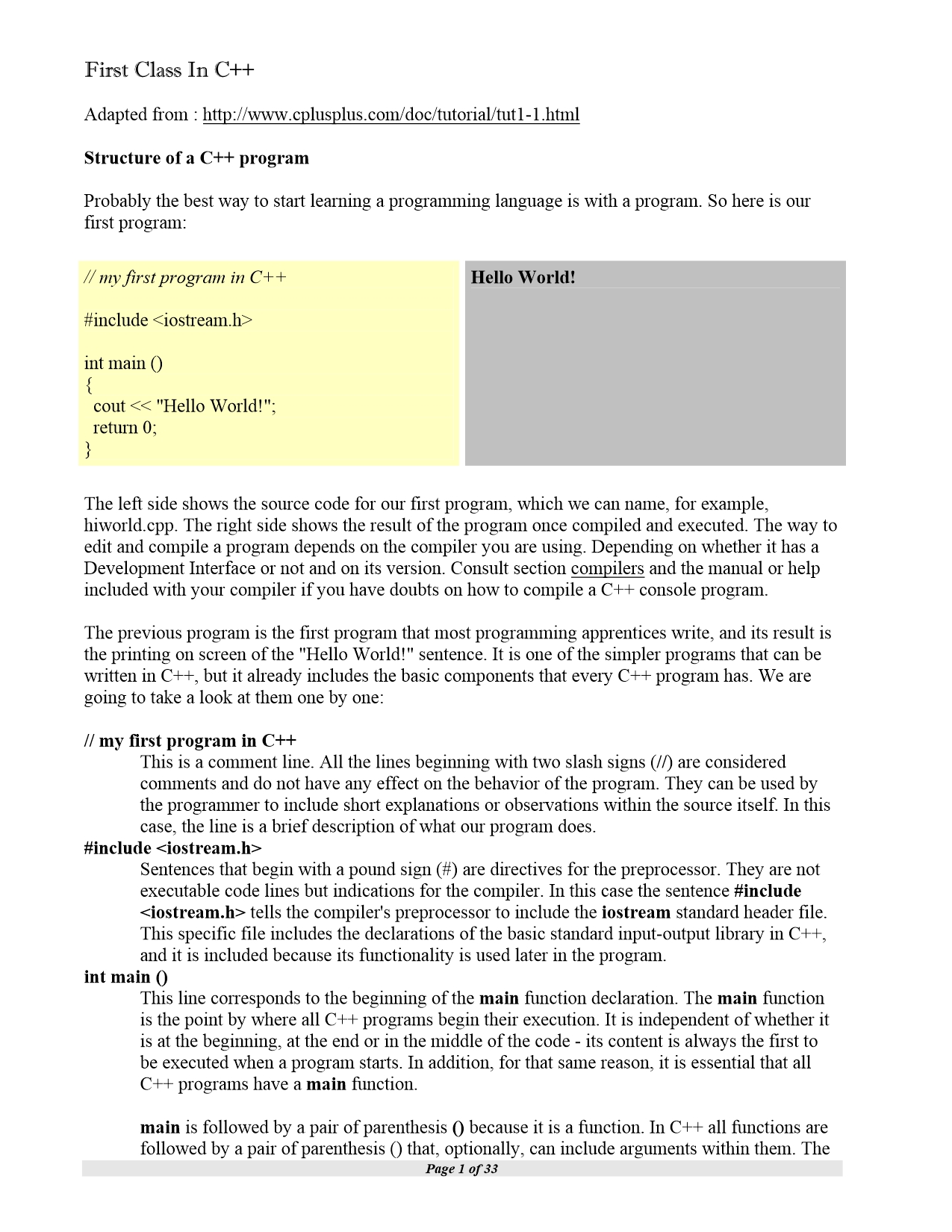
Probably the best way to start learning a programming language is with a program. So here is our
first program:
// my first program in C++
#include <iostream.h>
int main ()
{
cout << "Hello World!";
return 0;
}
Hello World!
The left side shows the source code for our first program, which we can name, for example,
hiworld.cpp. The right side shows the result of the program once compiled and executed. The way to
edit and compile a program depends on the compiler you are using. Depending on whether it has a
Development Interface or not and on its version. Consult section compilers and the manual or help
included with your compiler if you have doubts on how to compile a C++ console program.
The previous program is the first program that most programming apprentices write, and its result is
the printing on screen of the "Hello World!" sentence. It is one of the simpler programs that can be
written in C++, but it already includes the basic components that every C++ program has. We are
going to take a look at them one by one:
Below is the document preview.

Principles of Conflict of Laws Third Edition
Trending!
The document is a course textbook that contains the specifics of application of International and Municipal Laws, specifically where the two come into contact and it appears that only one or the other should apply. It introduces the concept and builds up into such concepts as forum shopping, superiority of municipal law, application of laws in foreign marriages, among others. It brings all in clear light, making it a necessary tool for students.
509 Pages
6048 Views
0 Downloads
1.69 MB
Law 514: Validity and Formality of Marriage
Trending!
The document provides the full exposition on the place of marriages under the different systems, where there arises conflict of various laws.
176 Pages
7958 Views
0 Downloads
764.05 KB
GPR 424: Nature and Scope of Conflict of Laws
Trending!
The document provides a summary of all the basic concepts of conflict of laws.
11 Pages
6069 Views
0 Downloads
216.49 KB
LLBK 319: SUMMARY OF CONCEPTS IN CONSUMER PROTECTION LAW
Trending!
A succinct introduction and summary of concepts on Consumer Protection law.
9 Pages
6755 Views
1 Downloads
445.96 KB
EPY 310 Topic 1: INTRODUCTION TO GROWTH AND DEVELOPEMENT
Trending!
Growth refers to the quantitative change that occurs in human beings. It is characterized by increase in size and weight. Development refers to patterns of change over time which begin at conception and continue throughout the life span. Development is both qualitative and quantitative in nature and takes place within the physical, social, cognitive and emotional domains. It occurs because of maturation and experience.
4 Pages
6765 Views
0 Downloads
131.98 KB
EPY 310 Topic 2: Psychoanalytic theory of human development
Trending!
Sigmund Freud argued strongly for the role of the unconscious and other internal processes in human development, behaviour and mental disorders. According to him, most of our behaviour and development is determined by the unconscious (innate aggressive and sexual urges- libido). The psychoanalytic school sees people as being in constant conflict between their biological urges (sex aggression, instincts – i.e. the id and the need to tame /control these urges by the super ego. The super-ego uses feelings of pride or guilt to achieve compliance.
11 Pages
7911 Views
0 Downloads
466.82 KB
EPY 310 Topic 3: Theory of Cognitive development
Trending!
While conducting intelligence tests on children, Swiss psychologist Jean Piaget began to investigate how children think. According to Piaget, children’s thought processes change as they mature physically and interact with the world around them. Piaget believed that children develop schema, or mental models, to represent the world. As children learn, they expand and modify their schema through the processes of assimilation and accommodation.
5 Pages
6502 Views
0 Downloads
388.84 KB
EPY 310 Topic 4: PRENATAL DEVELOPMENT
Trending!
The prenatal stage occurs during the nine months or so between conception and birth. As we will cover later on in this topic, the period in the womb can have a considerable impact on our later well-being. The nine months of prenatal development can be characterized as involving three periods...
6 Pages
6264 Views
0 Downloads
634.24 KB
EPY 310 Topic 6: Middle childhood (7 – 11years)
Trending!
Middle childhood covers the period 7-11 years while. This period is characterized by further development of the child in all domains, however the rate of development is not as rapid as it was during infancy and early childhood.
7 Pages
6132 Views
0 Downloads
565.68 KB
EPY 310 Topic 7: PARENTING STYLES AND THEIR EFFECTS ON THE ADOLESCENT
Trending!
A parent who is very responsive but not at all demanding is labelled indulgent , whereas one who is equally responsive but also very demanding is labelled authoritative. Parents who are very demanding but not responsive are Authoritarian. Parents who are neither demanding nor responsive are labelled indifferent.
4 Pages
6572 Views
0 Downloads
508.7 KB