 Join Our WhatsApp Channel for Updates!
B.TECH III YEAR – I SEM (R17)
| Institution | University |
| Course | Bachelor in Mathemat... |
| Year | 3rd Year |
| Semester | Unknown |
| Posted By | stephen oyake rabilo |
| File Type | |
| Pages | 60 Pages |
| File Size | 2.43 MB |
| Views | 4653 |
| Downloads | 0 |
| Price: |
Buy Now
 Buy via
whatsapp Buy via
whatsapp
|


Description
Object Oriented Programming is a paradigm that provides many concepts such as
inheritance, data binding, polymorphism etc.
Simula is considered as the first object-oriented programming language. The programming
paradigm where everything is represented as an object is known as truly object-oriented
programming language.
Smalltalk is considered as the first truly object-oriented programming language.
OOPs (Object Oriented Programming System)
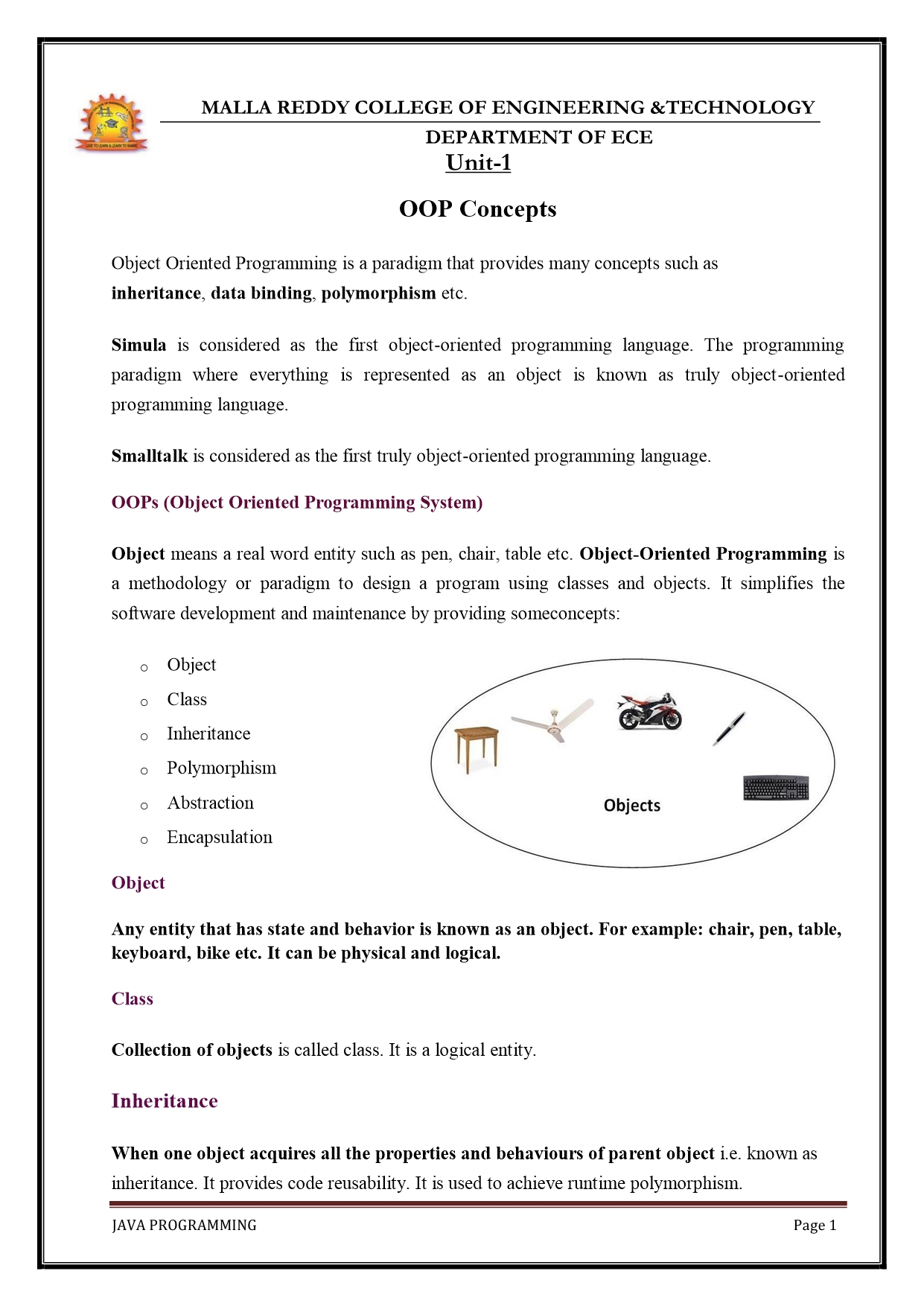
Object means a real word entity such as pen, chair, table etc. Object-Oriented Programming is
a methodology or paradigm to design a program using classes and objects. It simplifies the
software development and maintenance by providing someconcepts:
o Object
o Class
o Inheritance
o Polymorphism
o Abstraction
o Encapsulation
Object
Any entity that has state and behavior is known as an object. For example: chair, pen, table,
keyboard, bike etc. It can be physical and log
Below is the document preview.

HBC 2101: Accounting Principles Second Canadian Edition
Trending!
A merchandising company is an enterprise that buys and sells goods to earn a profit.
1. Wholesalers sell to retailers.
2. Retailers sell to consumers.
25 Pages
4084 Views
0 Downloads
265.27 KB
HBC 2101: Accounting Basics
Trending!
In accounting, there are two types of accounts: debit accounts and credit accounts. Under normal accounting circumstances, debit accounts have a positive balance and credit accounts have a negative balance. Along these same lines, each accounting transaction requires two entries: A debit entry and a credit entry. This is called double entry accounting.
2 Pages
4782 Views
0 Downloads
63.1 KB
CILS 2101: COMMUNICATION AND INFORMATION LITERACY SKILLS - full notes
Trending!
Welcome to Communication Skills! All human relations, be it formal or
non-formal, official or unofficial are created, developed and sustained through com-
munication. As such it is not only important to carry out communication as a means
to facilitating these relationships but to acquire it as an essential skill of life. This
basically underlines the necessity of the study of this unit as a whole.
159 Pages
5608 Views
0 Downloads
3.55 MB
COMS 110: COMMUNICATION SKILLS 1
Trending!
In this note, we shall examine the field of communication to serve as a foundation to what follows in the course. Principally, we shall define communication; outline its elements, principles and its importance in academic and life in general. We shall also briefly examine the various types of communication.
39 Pages
4564 Views
0 Downloads
724.03 KB
HRD 2101: LESSON 1 Introduction to Communication Skills
Trending!
Welcome to Communication Skills! All human relations, be it formal or non-formal, official or unofficial are created, developed and sustained through communication. As such it is not only important to carry out communication as a means to
facilitating these relationships but to acquire it as an essential skill of life.
56 Pages
5555 Views
1 Downloads
477.39 KB
HRD 2101: LESSON 2 Verbal Communication
Trending!
There are two forms of communication, namely verbal and non-verbal. Communication
by the spoken or written word, as we all may have noticed in our lives, is the most familiar and consciously acclaimed type of communication.
68 Pages
4472 Views
0 Downloads
1.5 MB
HRD 2101: LESSON 3 Patterns and Techniques in Communication
Trending!
The flow of information in an organisation is governed by its structure. In simple terms, organisational structure refers to the manner in which staff are arranged into departments and/or sections that handle different yet correlated tasks in the organisation.
24 Pages
4941 Views
0 Downloads
289.22 KB
HRD 2101: LESSON 4 Techniques in Communication
Trending!
Hearing- reception of sound. Sound strikes the eardrum causing vibrations. Passive activity. Listening- Hearing and interpreting sounds with an aim to understand the meaning behind the sounds. Active activity.
24 Pages
4653 Views
0 Downloads
293.16 KB
HRD 2101: LESSON 5 sources & use of technology in communication.
Trending!
Upon completion of this topic you should be able to:
Outline the types of interviews. Discuss the interview process - preparation and execution by both the interviewer and interviewee. Prepare and use questionnaires to collect data. Apply observation and experimentation techniques in collecting information for purposes of research.
37 Pages
4215 Views
0 Downloads
327.7 KB