 Join Our WhatsApp Channel for Updates!
INTRODUCTION TO SYSTEMS ANALYSIS AND DESIGN THEORY NOTES
| Institution | University |
| Course | IT |
| Year | 1st Year |
| Semester | Unknown |
| Posted By | Mwalimu Evans Okoyo. |
| File Type | |
| Pages | 105 Pages |
| File Size | 1.27 MB |
| Views | 5475 |
| Downloads | 0 |
| Price: |
Buy Now
 Buy via
whatsapp Buy via
whatsapp
|


Description
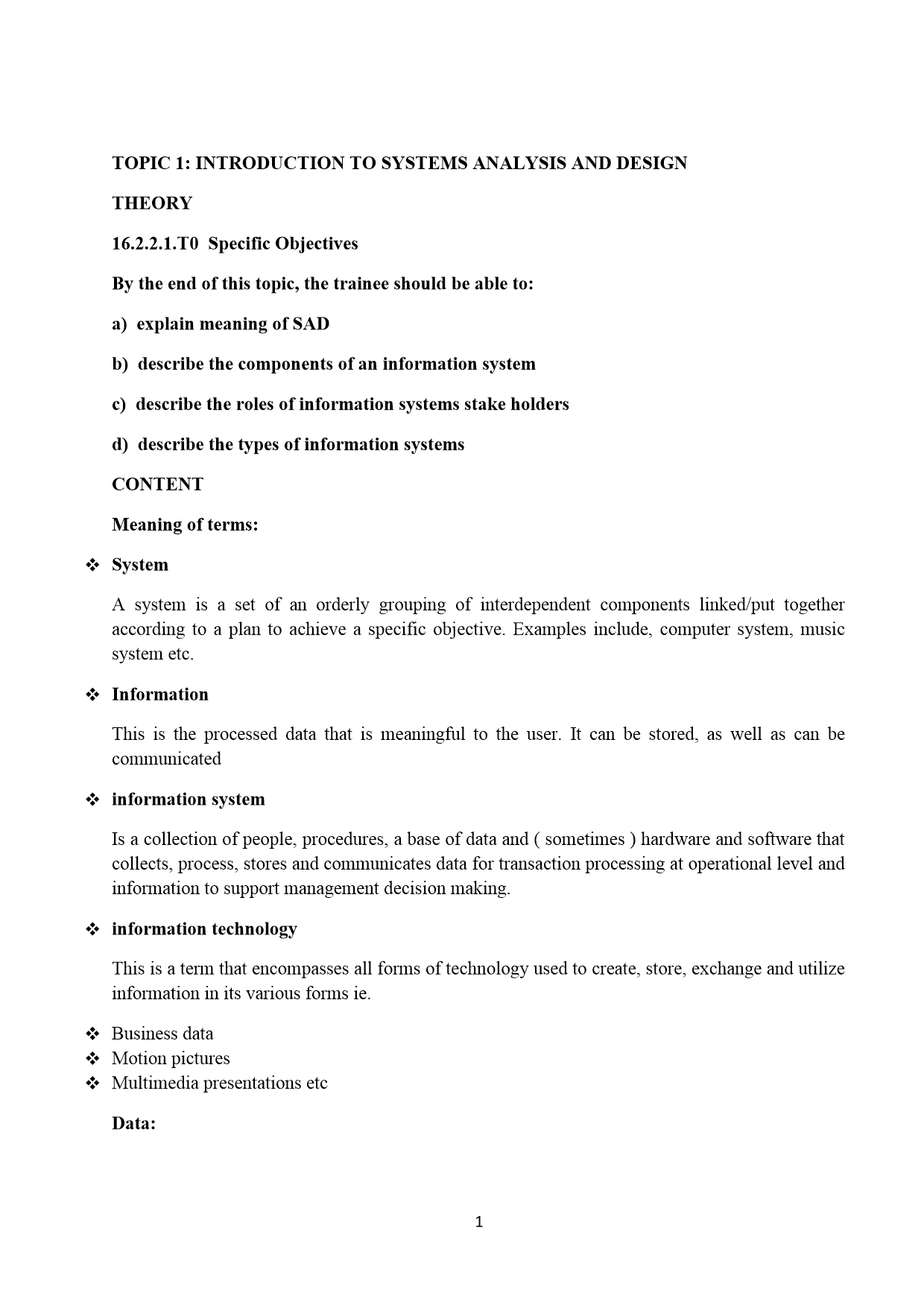
A system is a set of an orderly grouping of interdependent components linked/put together according to a plan to achieve a specific objective. Examples include, computer system, music system etc.
Below is the document preview.

SZL 2111: HIV/AIDs - Lesson 10
Trending!
General introduction: Public health and hygiene, human reproductive system, sex and sexuality. History of sexually transmitted diseases (STDs); History of Human Immunodeficiency virus/Acquired Immune deficiency Syndrome (HIV/AIDS), Compara-
tive information on trends, global and local distribution, Justification of importance of course.
38 Pages
6943 Views
0 Downloads
339.57 KB
SMA 2104: Mathematics for Sciences - Course Outline
Trending!
This unit aims at providing a good foundation in mathematics for students who plans to do more specialized work in the university, especially in the Computing, Medicine, Engineering, etc.
3 Pages
7437 Views
0 Downloads
266.54 KB
SMA 2104: Mathematics for Sciences - Lesson 1 Quadratic equations
Trending!
Upon completing this topic, you should be able to: Solve quadratic equations by factoring Learning outcomes Solve quadratic equations using the method of extraction of roots Determine the nature of the solutions to a quadratic equation Understand the logic underlying the method of completing Solve a quadratic equation using the method of completing
No pages found
8137 Views
0 Downloads
367.62 KB
SMA 2104 - MATHEMATICS FOR SCIENCE - Lesson 1B
Trending!
By the end of this topic you should be able to; Understand the laws of indices and their application in Learning outcomes simplifying algebraic expressions. Define index, Establish the laws of indices, Solve simple problems using the laws of indices, Understand the theory of logarithms and surds and their applications in manipulating expressions.
No pages found
6930 Views
0 Downloads
344.76 KB
SMA 2104: Mathematics for Sciences - Lesson 2 Algebra
Trending!
By the end of this topic you should be able to; Understand the laws of indices and their application in simplifying algebraic expressions. Define index, Establish the laws of indices, Solve simple problems using the laws of indices. Understand the theory of logarithms and surds and their applications in manipulating expressions. Define logarithm
No pages found
7857 Views
0 Downloads
344.76 KB
SMA 2104: Mathematics for Sciences - Lesson 3 Sequences and series
Trending!
Upon completing this topic, you should be able to:
Differentiate between a series and a sequence, Use Sigma notation in representing a series, Understand the properties of arithmetic and geometric progressions, Define an Arithmetic progression (A.P.), Obtain the formula for nth term and the first n terms of an A.P, Define a geometric progression (G.P.)
No pages found
7326 Views
0 Downloads
325.42 KB
SMA 2104: Mathematics for Sciences - Lesson 4 Factorisable polynomials
Trending!
Upon completing this topic, you should be able to factorise and solve polynomials of degree higher than 2
No pages found
7349 Views
0 Downloads
277.4 KB
SMA 2104: Mathematics for Sciences - Lesson 5 Permutations and Combination
Trending!
Permutations and Combination
Permutations - This is defined as the number of different ways of arranging different objects in order.
No pages found
7511 Views
0 Downloads
273.38 KB
SMA 2104: Mathematics for Sciences - Lesson 6 Binomial expansion
Trending!
Upon completing this topic you should be able to understand the binomial theorem and it’s application in the expansion of expressions and in approximations.
No pages found
6867 Views
0 Downloads
282.79 KB
SMA 2104: Mathematics for Sciences - Lesson 7 Probability
Trending!
Upon completing this topic,you should be able to;- Apply the principles of probability to solve problems in real-world contexts. Understand and use the language of probability and to compute the probabilities of composite events using the basic rules of probability.
No pages found
7722 Views
0 Downloads
395.57 KB