HEALTH INFORMATION SYSTEM(HIS)

Institution KTMC
Course Diploma in health re...
Year 1st Year
Semester Unknown
Posted By stephen oyake rabilo
File Type pdf
Pages 4 Pages
File Size 129.66 KB
Views 3631
Downloads 0
Price: Buy Now whatsapp Buy via whatsapp
  • whatsapp
  • facebook
  • twitter

Description

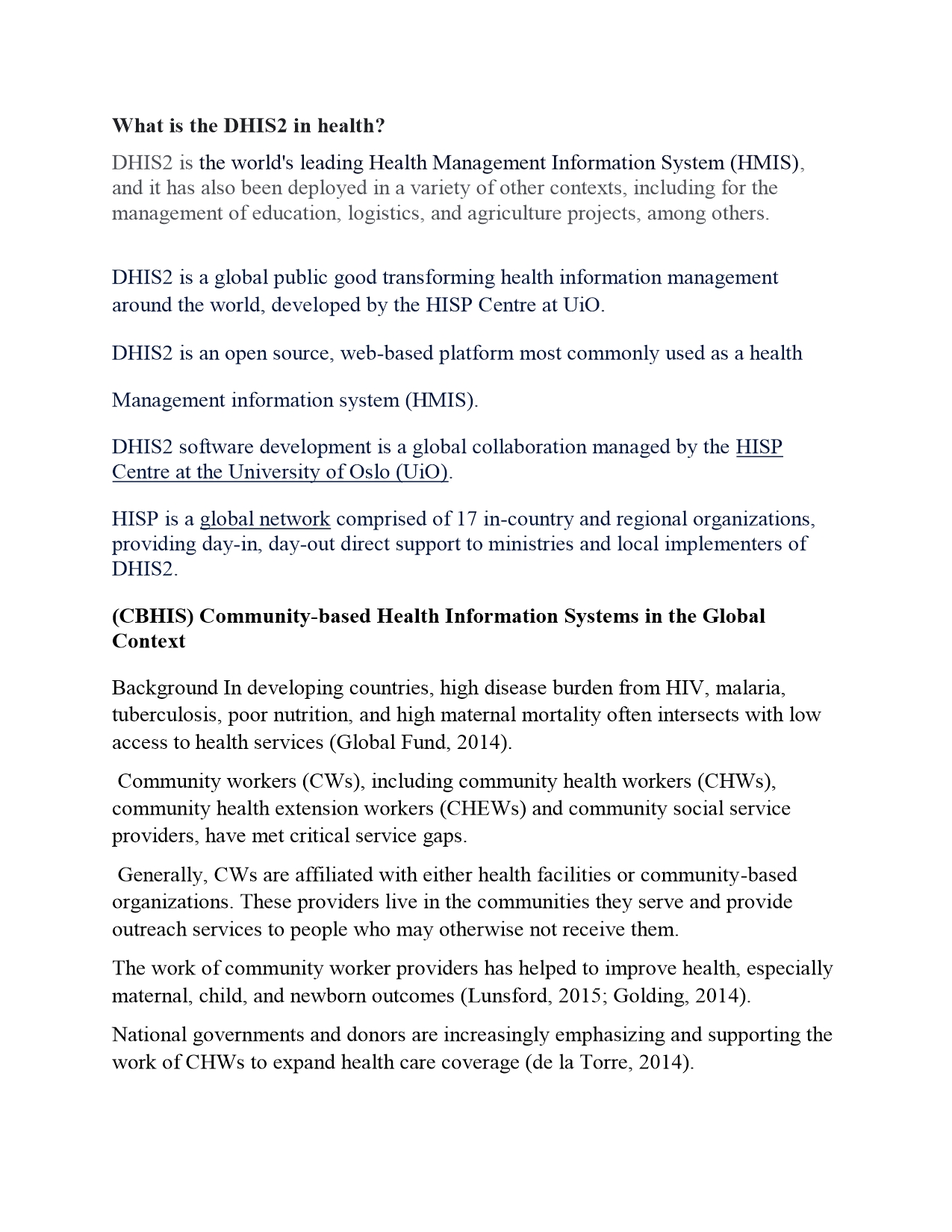
What is the DHIS2 in health? DHIS2 is the world's leading Health Management Information System (HMIS), and it has also been deployed in a variety of other contexts, including for the management of education, logistics, and agriculture projects, among others. DHIS2 is a global public good transforming health information management around the world, developed by the HISP Centre at UiO. DHIS2 is an open source, web-based platform most commonly used as a health Management information system (HMIS). DHIS2 software development is a global collaboration managed by the HISP Centre at the University of Oslo (UiO). HISP is a global network comprised of 17 in-country and regional organizations, providing day-in, day-out direct support to ministries and local implementers of DHIS2.
Below is the document preview.
No preview available
03 Huawei VRP Basics Trending!
The Versatile Routing Platform (VRP) is a universal operating system (OS) platform for Huawei datacom products. It is based on IP and adopts a component-based architecture. It provides rich features and functions, including application-based tailorable and extensible functions, greatly improving the running efficiency of the devices that use this OS. To efficiently manage such devices, you must be familiar with VRP and VRP-based configuration. This note describes the basic concepts, common commands, and command line interface (CLI) of VRP.
24 Pages 4212 Views 0 Downloads 661.22 KB
04 Network Layer Protocols and IP Addressing Trending!
Internet Protocol Version 4 (IPv4) is the core protocol suite in the TCP/IP protocol suite. It works at the network layer in the TCP/IP protocol stack and this layer corresponds to the network layer in the Open System Interconnection Reference Model (OSI RM). The network layer provides connectionless data transmission services. A network does not need to establish a connection before sending data packets. Each IP data packet is sent separately. This notes describes the basic concepts of IPv4 addresses, subnetting, network IP address planning, and basic IP address configuration.
42 Pages 3132 Views 0 Downloads 1.34 MB
05 IP Routing Basics Trending!
There are typically multiple IP subnets on a typical data communication network. Layer 3 devices are required to exchange data between these IP subnets. These devices have the routing capability and can forward data across subnets. Routing is the basic element of data communication networks. It is the process of selecting paths on a network along which packets are sent from a source to a destination. This note introduces the basic concepts of routing.
52 Pages 4048 Views 0 Downloads 1.93 MB
06 OSPF Basics Trending!
Static routes are manually configured. If a network topology changes, static routes have to be manually adjusted, which restricts the large-scale application of static routes on the live network. Dynamic routing protocols are widely used on live networks because of their high flexibility, high reliability, and easy scalability. The Open Shortest Path First (OSPF) protocol is a widely used dynamic routing protocol. This course describes basic concepts,working mechanism, and basic configurations of OSPF.
49 Pages 4077 Views 0 Downloads 1.18 MB
07 Ethernet Switching Basics Trending!
Data transmission on networks must comply with certain standards. Ethernet protocols define how data frames are transmitted over an Ethernet network. Understanding Ethernet protocols is the basis for fully understanding communication at the data link layer. An Ethernet switch is the main device for implementing data link layer communication. It is essential to understand how an Ethernet switch works. This note describes the concepts related to Ethernet protocols, MAC address types, and working process and mechanism of Layer 2 switches.
41 Pages 2941 Views 0 Downloads 1.24 MB
08 VLAN Principles and Configuration Trending!
Ethernet technology implements data communication over shared media based on carrier sense multiple access with collision detection (CSMA/CD). If there are a large number of PCs on the Ethernet, security risks and broadcast storms may occur, deteriorating network performance and even causing network breakdowns. The virtual local area network (VLAN) technology is therefore introduced to solve the preceding problem. This note describes basic VLAN principles, working principles of different Layer 2 interfaces, VLAN applications, data forwarding principles, and basic VLAN configuration methods.
46 Pages 4281 Views 0 Downloads 1.26 MB
09 STP Principles and Configuration Trending!
On an Ethernet switching network, redundant links are used to implement link backup and enhance network reliability. However, the use of redundant links may produce loops, leading to broadcast storms and an unstable MAC address table. As a result, communication on the network may deteriorate or even be interrupted. To prevent loops, IEEE introduced the Spanning Tree Protocol (STP). Devices running STP exchange STP Bridge Protocol Data Units (BPDUs) to discover loops on the network and block appropriate ports. This enables a ring topology to be trimmed into a loop-free tree topology, preventing infinite looping of packets and ensuring packet processing capabilities of devices. IEEE introduced the Rapid Spanning Tree Protocol (RSTP) to improve the network convergence speed.
60 Pages 4413 Views 1 Downloads 1.37 MB
10 Inter-VLAN Communication Trending!
By default, a Layer 2 switching network is a broadcast domain, which brings many problems. Virtual local area network (VLAN) technology isolates such broadcast domains, preventing users in different VLANs from communicating with each other. However, such users sometimes need to communicate. This course describes how to implement inter-VLAN communication.
30 Pages 4006 Views 0 Downloads 1.45 MB
11. Eth-Trunk, iStack, and CSS Trending!
As services develop and the campus network scale expands, users have increasingly demanding requirements on network bandwidth and reliability. Traditional solutions improve network bandwidth by upgrading devices and implement high reliability by deploying redundant links and using the Spanning Tree Protocol (STP), leading to low flexibility, time-consuming troubleshooting, and complex configuration. This chapter describes how to use Eth-Trunk, intelligent stack (iStack), and cluster switch system (CSS) technologies to improve network bandwidth and reliability.
48 Pages 4806 Views 0 Downloads 2.23 MB
12 ACL Principles and Configuration Trending!
Rapid network development brings challenges to network security and quality of service(QoS). Access control lists (ACLs) are closely related to network security and QoS. By accurately identifying packet flows on a network and working with other technologies, ACLs can control network access behaviors, prevent network attacks, and improve network bandwidth utilization, thereby ensuring network environment security and QoS reliability. This course describes the basic principles and functions of ACLs, types and characteristics of ACLs, basic composition of ACLs, ACL rule ID matching order, usage of wildcards, and ACL configurations.
27 Pages 4235 Views 0 Downloads 993.55 KB

