Lesson 5 Computer Animation - Skinning
| Institution | University |
| Course | BSc. Information Tec... |
| Year | 3rd Year |
| Semester | Unknown |
| Posted By | Jeff Odhiambo |
| File Type | |
| Pages | No pages found |
| File Size | 223.91 KB |
| Views | 9181 |
| Downloads | 0 |
| Price: |
Buy Now
 Buy via
whatsapp Buy via
whatsapp
|


Description
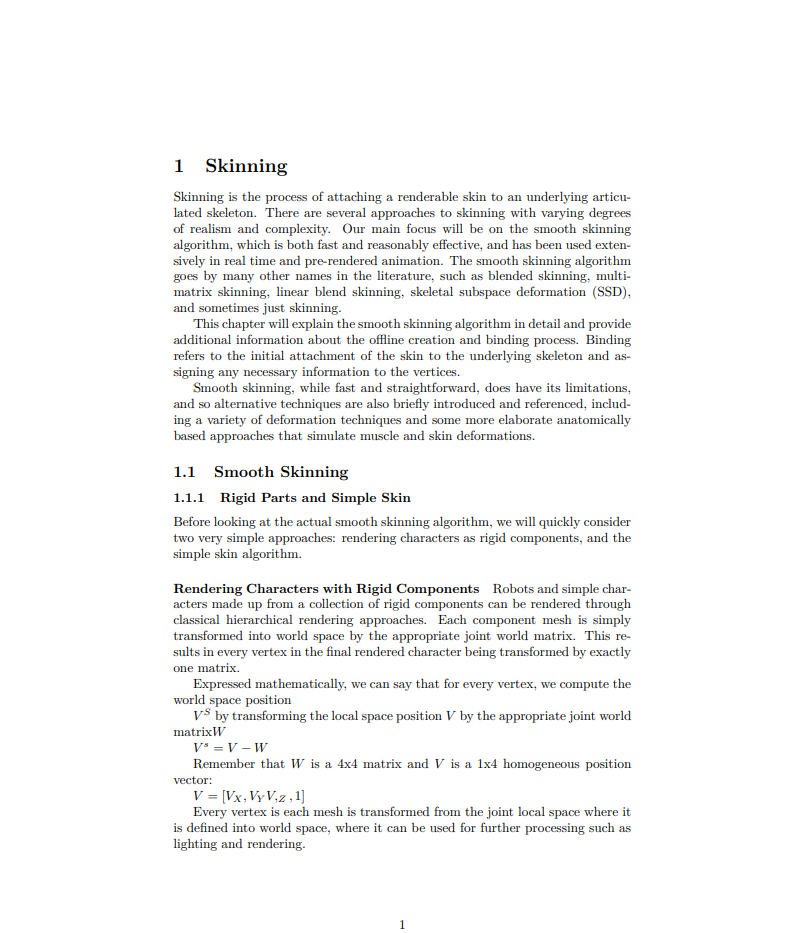
Skinning is the process of attaching a renderable skin to an underlying articulated skeleton. There are several approaches to skinning with varying degrees
of realism and complexity. Our main focus will be on the smooth skinning
algorithm, which is both fast and reasonably effective, and has been used extensively in real time and pre-rendered animation. The smooth skinning algorithm
goes by many other names in the literature, such as blended skinning, multimatrix skinning, linear blend skinning, skeletal subspace deformation (SSD),
and sometimes just skinning.
This chapter will explain the smooth skinning algorithm in detail and provide
additional information about the offline creation and binding process. Binding
refers to the initial attachment of the skin to the underlying skeleton and assigning any necessary information to the vertices.
Smooth skinning, while fast and straightforward, does have its limitations,
and so alternative techniques are also briefly introduced and referenced, including a variety of deformation techniques and some more elaborate anatomically
based approaches that simulate muscle and skin deformations
Below is the document preview.

THE GOLDEN AGE OF PHILOSOPHY – SOCRATES, PLATO &ARISTOTLE
Trending!
Socrates is said to have reacted against the teachings of the Sophists among whom he is sometimes grouped. He wanted to keep his native city of Athens from the moral destruction toward which the Sophists were leading it. Like the Sophists, he wandered from place to place discussing moral life and convictions with the people he met on the streets.
11 Pages
5672 Views
0 Downloads
259.42 KB
UCU 104: INTRODUCTION TO ETREPRENEURSHIP
Trending!
Entrepreneurship- is the process of creating something new with value by devoting the
necessary time and effort assuming the risks involved and receiving the resulting rewards inform of monetary gain personal satisfaction and independence.
111 Pages
9368 Views
1 Downloads
1.23 MB
UCU 112: CREATIVITY AND INNOVATION
Trending!
This module introduces you to the basic concepts, principles and issues in creativity and innovation. The module begins with clarification of the concepts, nature and scope of creativity. This enables you to clearly see and appreciate the distinction between creativity and innovation and the importance of both skills in the 21 st century.
99 Pages
9152 Views
2 Downloads
1.36 MB
UCU 103: CRITICAL AND CREATIVE THINKING
Trending!
The term philosophy is derived from a combination of two Greek words, namely philia
(love) and Sophia (wisdom) meaning love of wisdom. You may therefore, define philosophy as love of wisdom. This definition has persisted for more than two thousand years.
65 Pages
7491 Views
1 Downloads
608.04 KB
UCU 110 : COMMUNICATION AND COLLABORATIVE SKILLS FULL NOTES
Trending!
This course is aimed at helping you to develop the capacity to communicate effectively and efficiently in a variety of contexts, learn independently, collaborate with others, think critically as well as become an information literate citizen. This is a skills based course, which is taken by all the first year students across disciplines at the university.
90 Pages
12438 Views
8 Downloads
1.56 MB
SPH 300 TOPIC 1: PERIODIC MOTION
Trending!
Any motion that repeats itself in equal intervals of time is called periodic motion. If a particle in periodic motion moves back and forth over the same path, the motion is said to be oscillatory or vibratory. Oscillatory periodic systems are sources of harmonic waves. A system that executes periodic motion is under acceleration and this is the primary requirement for generating a harmonic wave.
14 Pages
7100 Views
0 Downloads
627.58 KB
SMA 300: REAL ANALYSIS I
Trending!
By the end of this course the learner will be able to: Construct the real number system and apply the concept of completeness in the set of real numbers and its topology, Prove and apply theorems associated with sequences of real numbers, Classify a given series of real numbers as convergent or divergent, Discuss properties of countable and uncountable sets and Distinguish between point wise and uniform continuity of real-valued functions.
22 Pages
7215 Views
0 Downloads
1.19 MB
APS 210: MOTIVATION AND EMOTION
Trending!
Motivation and Emotion covers areas of motivation and emotion that significantly relate to behavior and mental processes. Such areas include hunger, thirst, sex and the theories that explain the biological and psychological factors involved. An attempt is
made to tie in emotional experiences with motivations for behavior.
112 Pages
6075 Views
4 Downloads
992.26 KB
ECT 311: TEACHING METHODS IN LITERATURE
Trending!
This course description is made with appreciation of the reciprocity between Literature in English and English Language. It reflects the situation in Kenya where the two distinct subjects are integrated under the heading: English. Similarly, recent developments relating to the teaching of Literature in the modern secondary school have been adequately catered for.
164 Pages
10878 Views
1 Downloads
1.37 MB
SCU 801: KEY CONCEPTS IN SCIENTIFIC DATA ANALYSES
Trending!
In scientific research, the following terminologies are important and fundamental to the processes of data collecting, preparation, analysis, and reporting. As you will notice, not all the concepts are applicable to every case of data collection, analysis and reporting. Some of these concepts specifically apply to quantitative analysis while others are specific qualitative analysis.
10 Pages
7507 Views
0 Downloads
171.52 KB