 Join Our WhatsApp Channel for Updates!
Design & Analysis of Algorithm
| Institution | University |
| Course | BSc. Information Tec... |
| Year | 3rd Year |
| Semester | Unknown |
| Posted By | Jeff Odhiambo |
| File Type | |
| Pages | 638 Pages |
| File Size | 2.03 MB |
| Views | 5333 |
| Downloads | 0 |
| Price: |
Buy Now
 Buy via
whatsapp Buy via
whatsapp
|


Description
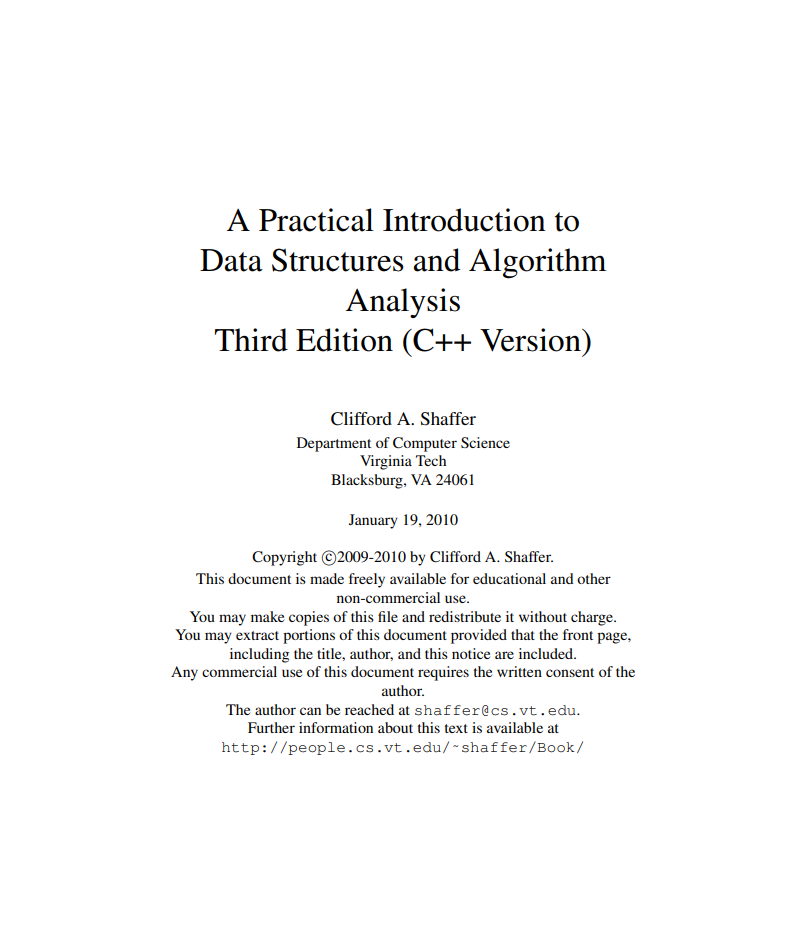
We study data structures so that we can learn to write more efficient programs. But
why must programs be efficient when new computers are faster every year? The
reason is that our ambitions grow with our capabilities. Instead of rendering efficiency needs obsolete, the modern revolution in computing power and storage capability merely raises the efficiency stakes as we computerize more complex tasks.
The quest for program efficiency need not and should not conflict with sound
design and clear coding. Creating efficient programs has little to do with “programming tricks” but rather is based on good organization of information and good algorithms. A programmer who has not mastered the basic principles of clear design
is not likely to write efficient programs. Conversely, “software engineering” cannot
be used as an excuse to justify inefficient performance. Generality in design can
and should be achieved without sacrificing performance, but this can only be done
if the designer understands how to measure performance and does so as an integral
part of the design and implementation process. Most computer science curricula
recognize that good programming skills begin with a strong emphasis on fundamental software engineering principles. Then, once a programmer has learned the
principles of clear program design and implementation, the next step is to study the
effects of data organization and algorithms on program efficiency
Below is the document preview.

DIRL 012: Foreign Policy
Trending!
The term foreign policy refers to a state's international goals and its strategies to achieve those goals. Foreign policy is the manner in which a country behaves toward other members of the international community. It involves a state setting an agenda and using its resources to achieve established goals.
4336 Views
1 Downloads
705.19 KB
FAMILY LAW
In one social context a family may refer to a man and a woman who share a common household. In another, it is defined as all persons who share blood relations. In others, it is defined as all persons who share a household. In others still it means all the members of a household, including parents and children with perhaps other relations, lodgers and even servants.
830 Views
0 Downloads
3.21 MB
Public International LAW
Public International law is that body of law which is composed of the principles and rules of conduct which states feel bound to and do observe in their relations to each other. It also includes rules of law relating to the function of international institutions or organizing their relations with each other and the states and to the individuals as well as certain rules of law relating to individuals and non-state entities in so far
as the rights and duties of such individuals and non-state entities are the concern of the international communities.
171 Pages
1353 Views
1 Downloads
1.77 MB
EPS 400: EDUCATIONAL STATISTICS AND EVALUATION
Trending!
The unit focuses on what statistics is and its uses in the context of education and counselling and other related areas. Its relationship to measurement (evaluation) is brought out by analyzing keys terms namely, data (numeric information), variable, continuous and discrete variable, descriptive and inferential statistics.
123 Pages
5553 Views
0 Downloads
2.75 MB
Introduction to Computer Application
Computer applications is the knowledge, skills and attitudes that enable a computer user to operate and use different computer application programs (software) or packages to accomplish various tasks.
25 Pages
1632 Views
0 Downloads
855.48 KB
PROBATE AND ADMNISTRATION
A limited grant is a grant that does not give the personal representative authority
to act with respect to the whole estate in all respects until the administration is
completed. It is a restricted grant. The grant may be limited as to special purpose,
property or time or it may be one of the special types.
23 Pages
463 Views
0 Downloads
194.96 KB
ATP 102: PROBATE AND ADMNISTRATION
Trending!
This is the branch of law that deals with inheritance. The concept of inheritance is universal to all societies irrespective of their legal system, ideology or religion. This arises out of three basic philosophical considerations:
138 Pages
3721 Views
0 Downloads
1.28 MB
LAW OF SUCCESSION
This is the branch of law that deals with inheritance. The concept of inheritance is universal to all societies irrespective of their legal system, ideology or religion. This arises out of three basic philosophical considerations: that man needs to acquire some property for his own sustenance and leading a good life. Inheritance is one of the means through which property is acquired, the fact that man dies and leaves behind his property that should continue to be owned by those who are left behind, and the fact that man instinctively wants to have some control over his property even upon his demise.
1107 Views
1 Downloads
1.01 MB
ATP 100: CIVIL LITIGATION
Trending!
Assuming the defendant has been served and opted not to defend the plaintiff may apply for judgment in default of defence. One has to find out whether they are entitled to final or interlocutory judgment both of which have different procedures. Assuming Defendant chooses to defend the action and as such has filed a defence.
126 Pages
4227 Views
8 Downloads
997.87 KB
CIVIL LITIGATION SUMMARY NOTES
Trending!
Civil litigation is a process of making or defending or resisting a claim form the beginning up to its successful end by the enforcement of a judgment, if it is made.
60 Pages
4176 Views
1 Downloads
1.11 MB