 Join Our WhatsApp Channel for Updates!
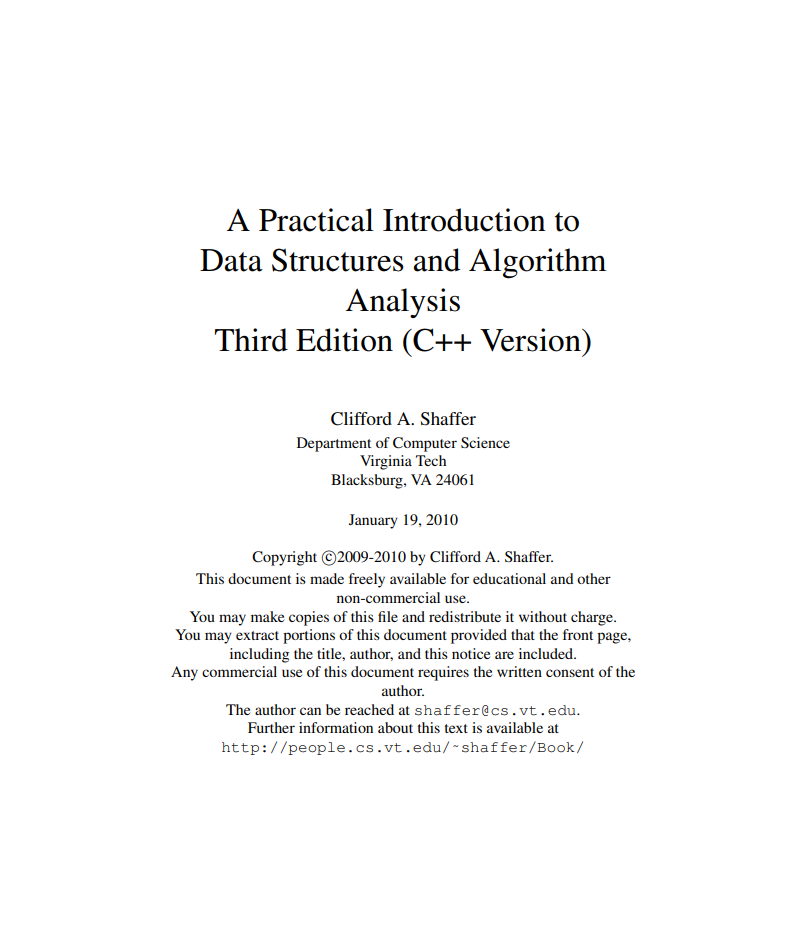
Design & Analysis of Algorithm
| Institution | University |
| Course | BSc. Information Tec... |
| Year | 3rd Year |
| Semester | Unknown |
| Posted By | Jeff Odhiambo |
| File Type | |
| Pages | 638 Pages |
| File Size | 2.03 MB |
| Views | 5161 |
| Downloads | 0 |
| Price: |
Buy Now
 Buy via
whatsapp Buy via
whatsapp
|


Description
We study data structures so that we can learn to write more efficient programs. But
why must programs be efficient when new computers are faster every year? The
reason is that our ambitions grow with our capabilities. Instead of rendering efficiency needs obsolete, the modern revolution in computing power and storage capability merely raises the efficiency stakes as we computerize more complex tasks.
The quest for program efficiency need not and should not conflict with sound
design and clear coding. Creating efficient programs has little to do with “programming tricks” but rather is based on good organization of information and good algorithms. A programmer who has not mastered the basic principles of clear design
is not likely to write efficient programs. Conversely, “software engineering” cannot
be used as an excuse to justify inefficient performance. Generality in design can
and should be achieved without sacrificing performance, but this can only be done
if the designer understands how to measure performance and does so as an integral
part of the design and implementation process. Most computer science curricula
recognize that good programming skills begin with a strong emphasis on fundamental software engineering principles. Then, once a programmer has learned the
principles of clear program design and implementation, the next step is to study the
effects of data organization and algorithms on program efficiency
Below is the document preview.

HUMAN ANATOMY & PHYSIOLOGY KMTC NOTES
Trending!
Homeostasis is any self-regulating process by which biological systems tend to maintain stability while adjusting to conditions that are optimal for survival. If homeostasis is successful, life continues; if unsuccessful, disaster or death ensues. The stability attained is actually a dynamic equilibrium, in which continuous change occurs yet relatively uniform conditions prevail.
109 Pages
5584 Views
1 Downloads
1.54 MB
AEN 400: Advanced Theoretical Studies In Grammar
Trending!
This course covers key areas in syntax and morphology from a theoretical perspective. In syntax, two approaches have been adopted: the formal and the functional. Issues in morphology are handled within generative grammar. However, as an entry point into the course, we begin by asking some basic questions about the study of language. Some of them you have encountered before but they appear here for recapping purposes.
75 Pages
3568 Views
1 Downloads
226.27 KB
EFN 412: COMPARATIVE EDUCATION
Trending!
Comparative education is a discipline within the field of education. Its main purpose is to
enlighten the teacher trainee on issues of educational systems in other countries with a
view of broadening their perspective on educational problems and attempted solution.
41 Pages
3924 Views
0 Downloads
1.27 MB
EFN 412 :COMPARATIVE EDUCATION
Trending!
Comparative education is a fully established academic field of study that examines
education in one country (or group of countries) by using data and insights drawn from the practices and situation in another country, or countries. Programs and courses in comparative education are offered in many universities throughout the world, and relevant studies are regularly published in scholarly journals such as Comparative Education, International Review of Education, International Journal of Educational
Development, and Comparative Education Review. The field of comparative education is supported by many projects associated with UNESCO and the national education ministries of various nations.
41 Pages
4213 Views
0 Downloads
1.27 MB
MATHEMATICS FORM 2 TERM 3 END YEAR FULL EXAMS WITH MARKING SCHEMES
Trending!
Get a copy of the MATHEMATICS FORM 2 TERM 3 END YEAR FULL EXAMS WITH MARKING SCHEMES. This is a well set and moderated exam paper with a well coordinated comprehensive marking scheme attached herein. Attached is also the EDITABLE Question Papers that you can customize to your preference.
16 Pages
6741 Views
1 Downloads
973.02 KB
BLOOD PHYSIOLOGY
Trending!
A liquid connective tissue that flows through blood vessels
It forms part of ECF body fluids.
71 Pages
3575 Views
0 Downloads
2.26 MB
DIGESTIVE SYSTEM PHYSIOLOGY
Trending!
The digestive system consists group of organs working together to convert food into basic nutrients that provide energy for the entire body.
41 Pages
4662 Views
0 Downloads
2.83 MB
Y3S1:Psychiatric Nursing: Historical Perspectives
Trending!
Mental is defined as of mind: while the mind is defined as the seat of consciousness, thought and feeling. Mental health therefore means a state of wellbeing of the mind - (Dictionary.com)Mental health: the successful adaptation to stressors from the internal or external environment, evidenced by thoughts, feelings, and behaviors that are age appropriate and congruent with local and cultural norms (Robinson, 1983)
59 Pages
4685 Views
0 Downloads
969.12 KB
PSYCHOPHARMACOLOGY
Trending!
Psychopharmacology refers to the use of drugs in managing psychiatric conditions
– Schizophrenia
– Depression
– Mania
– Anxiety
64 Pages
6175 Views
0 Downloads
1.37 MB
MATHEMATICS FORM 1 TERM 3 END YEAR FULL EXAMS WITH MARKING SCHEMES
Trending!
Get a copy of the MATHEMATICS FORM 1 TERM 3 END YEAR FULL EXAMS WITH MARKING SCHEMES. This is a well set and moderated exam paper with a well coordinated comprehensive marking scheme attached herein. Attached is also the EDITABLE Question Papers that you can customize to your preference.
16 Pages
5981 Views
1 Downloads
1003.05 KB