Expanding Social Horizons: Socioemotional Development in Middle Childhood
| Institution | Keiser University |
| Course | Pschology |
| Year | 4th Year |
| Semester | Unknown |
| Posted By | Faith Kagwi |
| File Type | |
| Pages | 34 Pages |
| File Size | 174.87 KB |
| Views | 6428 |
| Downloads | 0 |
| Price: |
Buy Now
 Buy via
whatsapp Buy via
whatsapp
|


Description
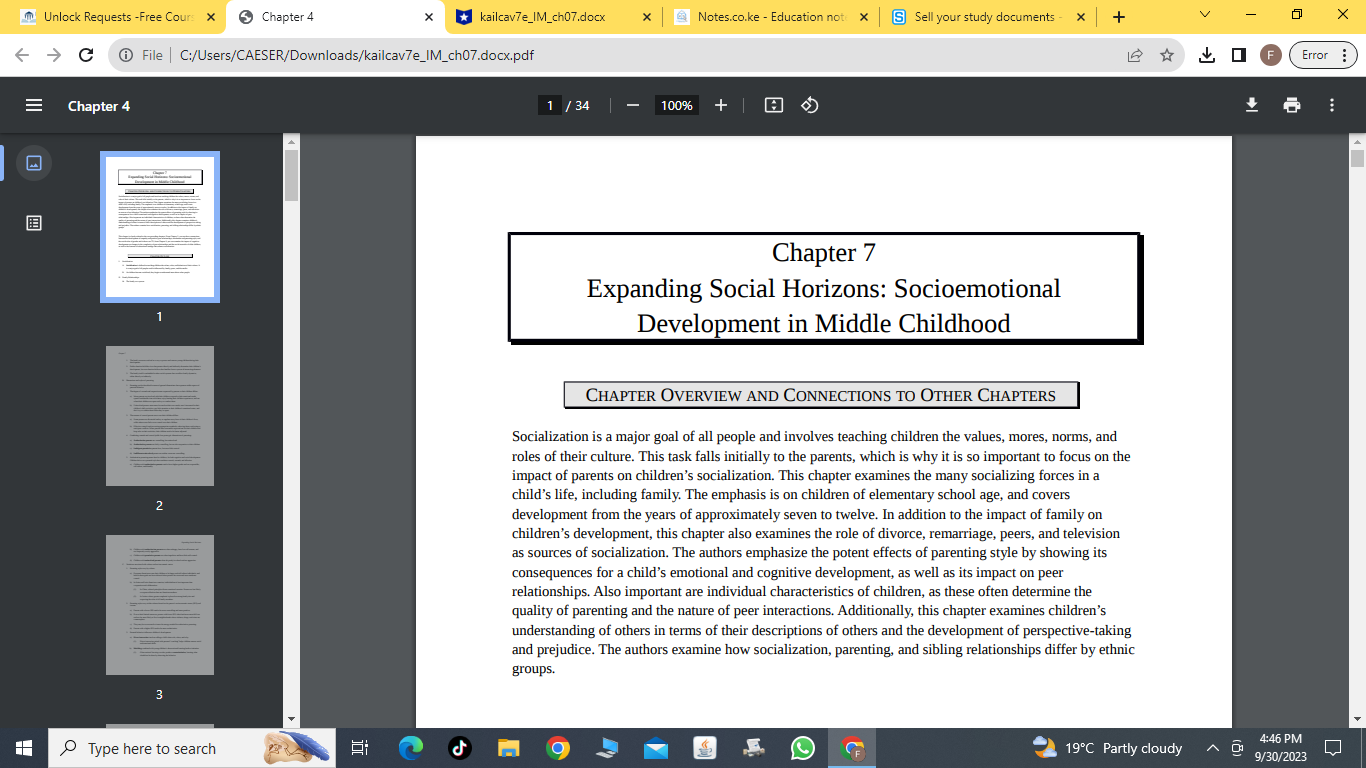
CHAPTER OVERVIEW AND CONNECTIONS TO OTHER CHAPTERS
Socialization is a major goal of all people and involves teaching children the values, mores, norms, and
roles of their culture. This task falls initially to the parents, which is why it is so important to focus on the
impact of parents on children’s socialization. This chapter examines the many socializing forces in a
child’s life, including family. The emphasis is on children of elementary school age, and covers
development from the years of approximately seven to twelve. In addition to the impact of family on
children’s development, this chapter also examines the role of divorce, remarriage, peers, and television
as sources of socialization. The authors emphasize the potent effects of parenting style by showing its
consequences for a child’s emotional and cognitive development, as well as its impact on peer
relationships. Also important are individual characteristics of children, as these often determine the
quality of parenting and the nature of peer interactions. Additionally, this chapter examines children’s
understanding of others in terms of their descriptions of others and the development of perspective-taking
and prejudice. The authors examine how socialization, parenting, and sibling relationships differ by ethnic
groups.
This chapter is closely related to the two preceding chapters. From Chapter 5, you can draw connections
between the development of empathy and positive peer relationships, attachment and parenting style, and
the social roles of gender and violence on TV; from Chapter 6, you can examine the impact of cognitive
development on changes in the complexity of peer relationships and the social networks of older children,
as well as the features of educational settings that enhance socialization.
Below is the document preview.

BIT 2103:Microsoft PowerPoint
Trending!
Microsoft PowerPoint is a presentation software developed by Microsoft, widely used for creating professional slideshows that combine text, images, graphics, animations, and multimedia. It is part of the Microsoft Office suite and is compatible with Windows, macOS, and mobile platforms.
21 Pages
10063 Views
0 Downloads
1.24 MB
AEN 401: VARIETIES OF ENGLISH
Trending!
This module is organized around thirteen major topics. We will first introduce you to the sources of variation which have precipitated the different varieties of English and explain the three major levels of language variation: phonological, lexical and morpho- syntactic. We will then examine the notion of language standardization and discuss different approaches that have been used in classifying the World Englishes.
86 Pages
9579 Views
2 Downloads
1.2 MB
Law of Torts in Kenya
Trending!
There are two types of civil wrongs, and we looked at the first of these - i.e. those arising from a breach of contract. The second type of civil wrong arises from the breach of a duty fixed by law, and owed to people generally and is called a “Tort”.
43 Pages
10001 Views
0 Downloads
585.39 KB
BIT 2103: Lesson 6 Mail Merge
Trending!
The Mail Merge feature of Microsoft Word is a great way to produce a large number of
personalized letters or labels in a short amount of time. The process can seem daunting to a
beginner, but if you break it down into a series of steps, is very easy to manage.
6 Pages
9992 Views
0 Downloads
177.16 KB
INTRODUCTION TO THE LAW OF TORTS
Trending!
Human interactions in the social sphere is bound to create conflicts of interest leading to injury or losses to other people – road use; use of buildings; seeking professional help, sports etc. When these injuries occur, society should have a mechanism of apportioning blame and ensuring reparations. The law of tort is one such mechanism that has been developed by society to apportion responsibility for losses that occur in society.
78 Pages
9515 Views
1 Downloads
1.02 MB
BIT 2103: Lesson 3 Basic tasks in Word.
Trending!
The backstage view helps for creating new documents, saving and opening documents etc.
49 Pages
10124 Views
0 Downloads
2.8 MB
BIT 2103: Lesson 2 Word Processing.
Trending!
A word processor is a program designed for creating and editing
business and personal documents that are primarily text-based.
Most modern word processors enable you to customize fonts and
formatting - and they often include images and other multimedia
files - such as videos and audio clips.
9 Pages
10553 Views
0 Downloads
215.29 KB
BIT 2103: What is HTML
Trending!
HTML represents the standard markup language for creating web pages online.
It stands for Hyper Text Markup Language.
5 Pages
10083 Views
0 Downloads
97.48 KB
BIT 2103: Lesson 4 Ms Excel
Trending!
This tip describes how to use conditional formatting for comfortable viewing results in the
worksheet.
14 Pages
10066 Views
0 Downloads
303.23 KB
BIT 2103: Lesson 3 Ms Excel
Trending!
If you create a custom list in Excel, you can easily fill a range with your own list of
departments, clients, cities, credit card numbers, etc. This can save time and reduce errors
3 Pages
10453 Views
0 Downloads
81.88 KB