Expanding Social Horizons: Socioemotional Development in Middle Childhood
| Institution | Keiser University |
| Course | Pschology |
| Year | 4th Year |
| Semester | Unknown |
| Posted By | Faith Kagwi |
| File Type | |
| Pages | 34 Pages |
| File Size | 174.87 KB |
| Views | 5357 |
| Downloads | 0 |
| Price: |
Buy Now
 Buy via
whatsapp Buy via
whatsapp
|


Description
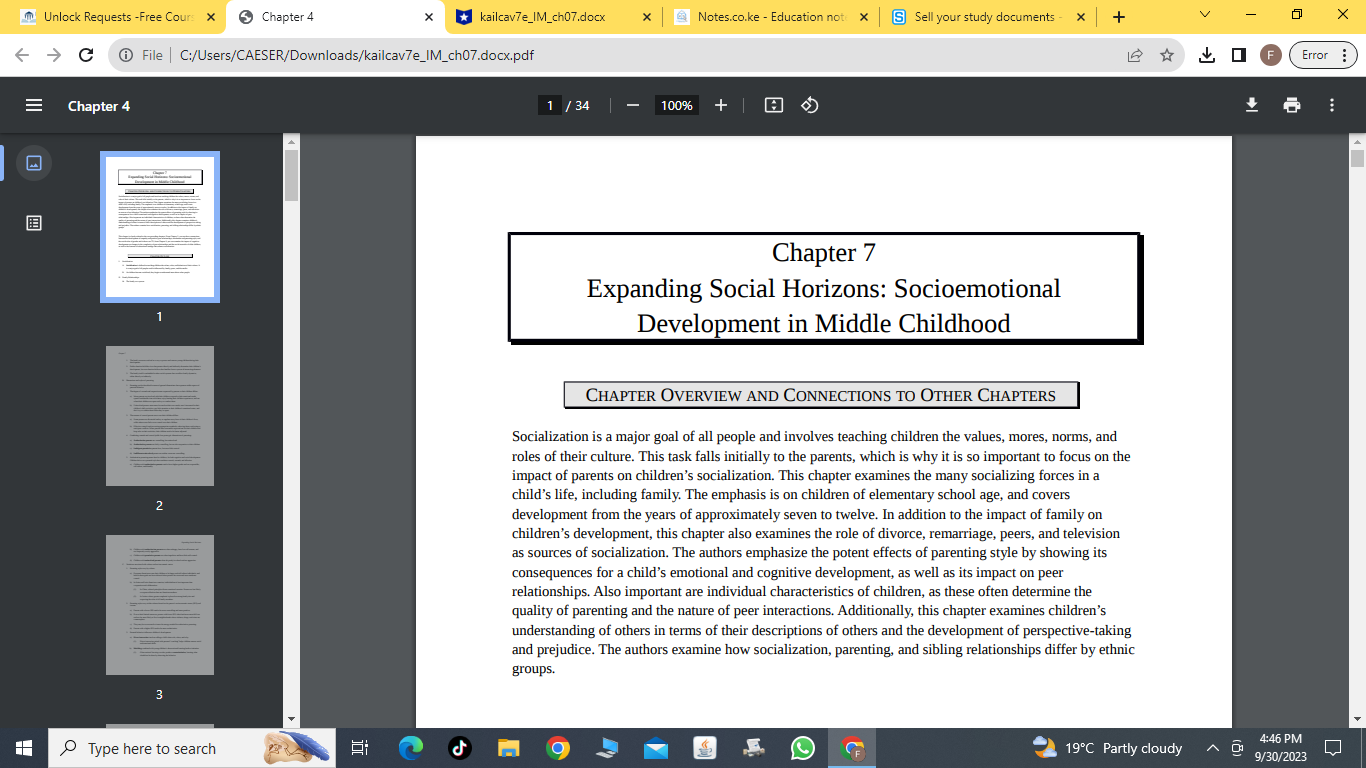
CHAPTER OVERVIEW AND CONNECTIONS TO OTHER CHAPTERS
Socialization is a major goal of all people and involves teaching children the values, mores, norms, and
roles of their culture. This task falls initially to the parents, which is why it is so important to focus on the
impact of parents on children’s socialization. This chapter examines the many socializing forces in a
child’s life, including family. The emphasis is on children of elementary school age, and covers
development from the years of approximately seven to twelve. In addition to the impact of family on
children’s development, this chapter also examines the role of divorce, remarriage, peers, and television
as sources of socialization. The authors emphasize the potent effects of parenting style by showing its
consequences for a child’s emotional and cognitive development, as well as its impact on peer
relationships. Also important are individual characteristics of children, as these often determine the
quality of parenting and the nature of peer interactions. Additionally, this chapter examines children’s
understanding of others in terms of their descriptions of others and the development of perspective-taking
and prejudice. The authors examine how socialization, parenting, and sibling relationships differ by ethnic
groups.
This chapter is closely related to the two preceding chapters. From Chapter 5, you can draw connections
between the development of empathy and positive peer relationships, attachment and parenting style, and
the social roles of gender and violence on TV; from Chapter 6, you can examine the impact of cognitive
development on changes in the complexity of peer relationships and the social networks of older children,
as well as the features of educational settings that enhance socialization.
Below is the document preview.

WIPO - Intellectual Property Handbook: Policy, Law and Use
Trending!
A complete handbook on WIPO's IP policy, law and use guidelines.
494 Pages
5114 Views
0 Downloads
2.33 MB
Criminal Litigation: Practice and Procedure
Trending!
A full dive-in for an understanding of criminal litigation practice and procedure.
570 Pages
5127 Views
0 Downloads
4.58 MB
SZL 200: Vertebrate Zoology Notes 2nd Year
Recommended!
Trending!
The Following Is A Copy Of Kenyatta University SZL 200 Notes On Vertebrates.
150 Pages
7772 Views
68 Downloads
3.54 MB
Price: FREE
Download
INTROCTION TO CATERING PREMISES
Trending!
INTRODUCTION TO CATERING PREMISES
Definition of terms
1. Plant and premises- a plant is a building area mainly used by industries and
premises are slightly smaller than plant
2. Catering outlets- they are various sectors of catering industries where activities
take place
3. Catering systems- are various methods used in preparation, production and
service of food and beverage e.g. cook freeze, convectional cooking
4. Work flow – sequence in which activities follow one another and should be
easy for the work force to follow
5. Building fabrics – materials used to construct a building or a plant e.g. stones,
timber, iron sheet
6. Catering processes – the flow of items from one department to another e.g
receiving goods – storing – issuing – production/preparation and selling
Objectives of catering management
1. Assists the catering to understand the systems of catering layout and the
arrangement of property e.g. large equipment
2. Assist on how to use catering equipment correctly and specifically
3. Helps caterer to be able to select appropriate equipment for a particular catering
outlet
37 Pages
6784 Views
0 Downloads
819.08 KB
SERVICE TECHNICAL SKILLS
1. Lay the napkin face down in front of you.
2. Fold the napkin in half.
3. Fold the napkin in quarters.
4. Fold the napkin in half diagonally, creating a triangle.
5. Orient the triangle so the open tip is facing away from you.
6. Fold the right corner diagonally towards you – laying it down along the centreline of
the triangle, making a new tip pointing towards you. An iron can make this important
fold a whole lot easier.
7. Do the same with the left corner, fold it diagonally toward you and press it down next
to the previous fold. Now you have a diamond, you’re rich! Yay!
8. Fold the two "wings" that you just made in folds 6 and 7 under so that you have your
original triangle shape back. Once again an iron can make a world of difference.
9. Fold the triangle in half by bringing the centre seam towards you and allowing the
ends to fall.
10. This bird’s almost ready to fly, but first you must give it some feathers. While holding
the base firmly to keep your folds together, pull up the four ‘flaps’ created by the
napkin’s corners
73 Pages
383 Views
0 Downloads
2.21 MB
SERVICE TECHNICAL SKILLS
In the recent years, eating away from home has bean on the increase
and there is a widening diversity in the nature and the type of food and
beverage on offer.
The hospitality industry (Catering/Hotel industry) has a greatly expanded
demanding improved professionalism in food and beverage service staff.
There is even greater need for more people to make their career in this
noble profession alongside the need for improved confidence and
performance through higher standards of knowledge and skills.
Food and beverage service staffs are employed in huge variety of
establishments in the hospitality industry, but their basic roles does not
differ no matter what type of restaurant, hospitals or other venue they
work in. The number of food and beverage service staff and their positions in an
establishment hierarchy depend on their size of operation and service
offered. The function of the waiting staff; large, medium or
small establishments remain the same.
322 Pages
407 Views
0 Downloads
5.44 MB
Analogue Electronics 2
Trending!
This term signal diode includes all devices that have been designed for use in circuits where large current and voltage ratings are not required. The usual requirements are for a large reverse resistance/forward resistance ratio and minimum junction capacitance.
86 Pages
8082 Views
0 Downloads
3.43 MB
INTRODUCTION TO SOLAR TECHNOLOGIES
Trending!
Solar electricity is electric power generated from sunlight using devices called solar cell
modules. Solar electricity can replace, cost-effectively, small applications of petroleum-fueled generators, grid power and even dry cell batteries.
58 Pages
8373 Views
0 Downloads
1.34 MB
Medical-Legal Ethics
Trending!
A summary of the application of medical-legal ethics for nurses, doctors and other direct care medical professionals.
53 Pages
8994 Views
2 Downloads
337.68 KB
POTT/D/234 PERIOPERATIVE THEATRE TECHNOLOGY
Trending!
An outline of all perioperative procedures and conduct in the theatre.
153 Pages
8902 Views
0 Downloads
839.52 KB