Expanding Social Horizons: Socioemotional Development in Middle Childhood
| Institution | Keiser University |
| Course | Pschology |
| Year | 4th Year |
| Semester | Unknown |
| Posted By | Faith Kagwi |
| File Type | |
| Pages | 34 Pages |
| File Size | 174.87 KB |
| Views | 5372 |
| Downloads | 0 |
| Price: |
Buy Now
 Buy via
whatsapp Buy via
whatsapp
|


Description
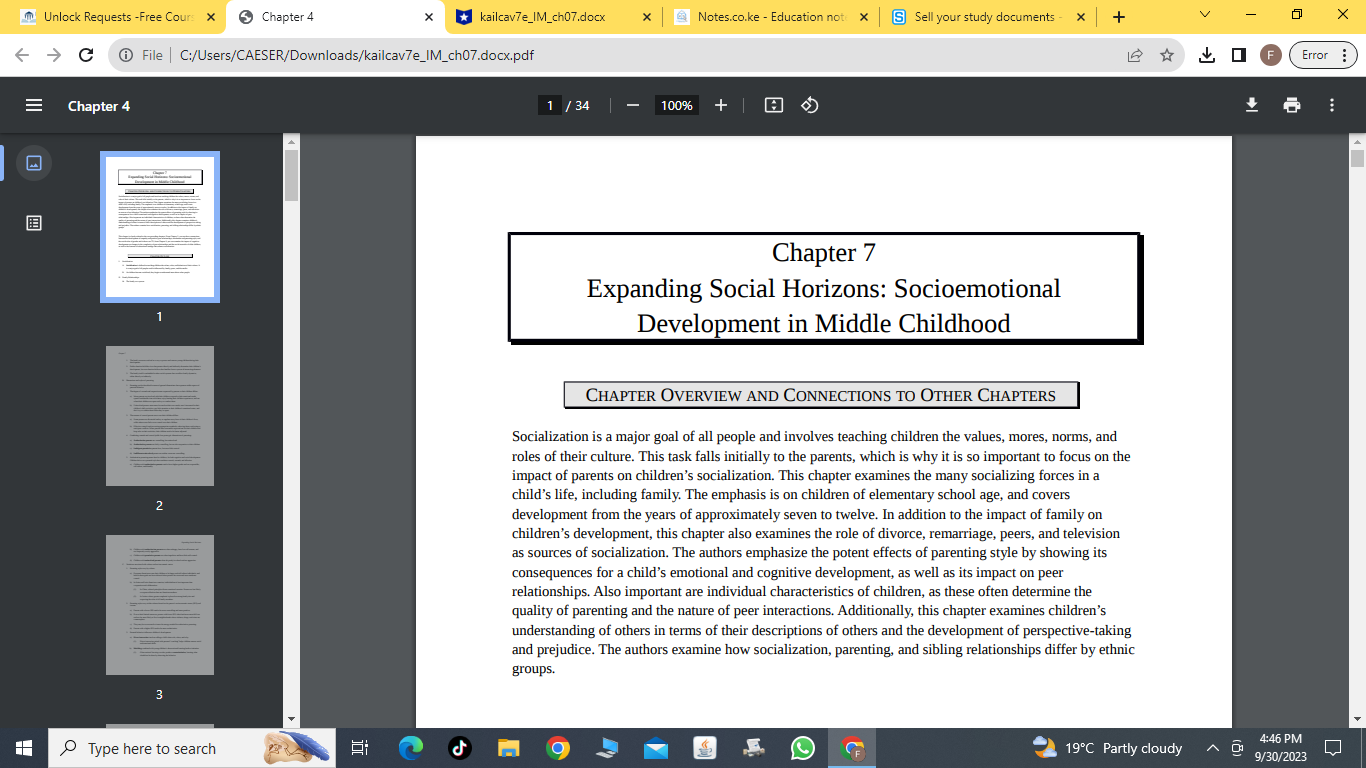
CHAPTER OVERVIEW AND CONNECTIONS TO OTHER CHAPTERS
Socialization is a major goal of all people and involves teaching children the values, mores, norms, and
roles of their culture. This task falls initially to the parents, which is why it is so important to focus on the
impact of parents on children’s socialization. This chapter examines the many socializing forces in a
child’s life, including family. The emphasis is on children of elementary school age, and covers
development from the years of approximately seven to twelve. In addition to the impact of family on
children’s development, this chapter also examines the role of divorce, remarriage, peers, and television
as sources of socialization. The authors emphasize the potent effects of parenting style by showing its
consequences for a child’s emotional and cognitive development, as well as its impact on peer
relationships. Also important are individual characteristics of children, as these often determine the
quality of parenting and the nature of peer interactions. Additionally, this chapter examines children’s
understanding of others in terms of their descriptions of others and the development of perspective-taking
and prejudice. The authors examine how socialization, parenting, and sibling relationships differ by ethnic
groups.
This chapter is closely related to the two preceding chapters. From Chapter 5, you can draw connections
between the development of empathy and positive peer relationships, attachment and parenting style, and
the social roles of gender and violence on TV; from Chapter 6, you can examine the impact of cognitive
development on changes in the complexity of peer relationships and the social networks of older children,
as well as the features of educational settings that enhance socialization.
Below is the document preview.

CBC GRADE 2 EXAMS SET 2
Trending!
Download a copy of the CBC GRADE 2 EXAMS SET 2. The Document contains all the Subject Areas in Grade 2. This can be very resourceful in evaluating your learners.
12 Pages
7525 Views
0 Downloads
514.18 KB
CBC GRADE 2 EXAMS SET 3
Trending!
Download a copy of the CBC GRADE 2 EXAMS SET 3. The Document contains all the Subject Areas in Grade 2. This can be very resourceful in evaluating your learners.
15 Pages
7371 Views
1 Downloads
575.6 KB
GRADE 2 PREMIUM ASSESSMENT TEST
Trending!
Download a copy of the GRADE 2 PREMIUM ASSESSMENT TEST. The Document contains all the Subject Areas in Grade 2. This can be very resourceful in evaluating your learners.
14 Pages
8574 Views
0 Downloads
458.05 KB
SMA 101: BASIC MATHEMATICS
Trending!
This text is designed as a one-semester introduction to mathematics course to be taken
by students in a wide variety of majors, including mathematics, actuarial science, statistics, chemistry, physics, meteorology, geology, computer science,engineering, economics,
business and other social sciences.
144 Pages
9579 Views
7 Downloads
1.09 MB
SBT 101: SURVEY OF THE PLANT KINGDOM
Trending!
This course aims at introducing the learner to all groups of plants to be studied during
the whole of the Bachelors course. The major morphological; identification features and
the life cycles are covered from all the major plant groups.
156 Pages
7689 Views
3 Downloads
4.95 MB
EPS 100: INTRODUCTION TO PSYCHOLOGY
Trending!
In this introductory lecture, I shall first introduce you to the definition of the term
psychology, after which I will focus on the psychological perspectives that are currently
used in the study of behavior and mental processes
75 Pages
9449 Views
5 Downloads
512.37 KB
SZL 100: GENERAL ZOOLOGY
The current space explorations seem to suggest that life exist in other planets. The sun, the
earth, and the other planets belong to the solar system that occurs towards the outer edge of
the Milky Way. The Milky Way is just one of the over 10 billion galaxies. A galaxy is any of
the large star systems held together by gravitational pull. A Milky Way is a defuse band of
light stretching across our sky with millions of faint stars and is visible on clear nights
102 Pages
623 Views
3 Downloads
463.36 KB
SZL 100: GENERAL ZOOLOGY
The current space explorations seem to suggest that life exist in other planets. The sun, the
earth, and the other planets belong to the solar system that occurs towards the outer edge of
the Milky Way. The Milky Way is just one of the over 10 billion galaxies. A galaxy is any of
the large star systems held together by gravitational pull. A Milky Way is a defuse band of
light stretching across our sky with millions of faint stars and is visible on clear nights
102 Pages
364 Views
2 Downloads
463.36 KB
SCH 100: Fundamentals of Inorganic Chemistry
Trending!
Fundamental of Inorganic chemistry is a core unit in chemistry at the undergraduate level for
the Bachelor of Education as well as Bachelor of Science degrees. The unit aims at
introducing the learner to various basic concepts in chemistry. It endeavours to equip the
learner with sufficient knowledge to enable him/her to comprehend and relate to other
concepts encountered at a later stage, as he or she dwells more in chemistry and other related
sciences.
84 Pages
8899 Views
4 Downloads
1.47 MB
Biology Form 4 Notes
Trending!
Genetics is the study of how genes and how traits are passed down from one generation to the next. Our genes carry information that affects our health, our appearance, and even our personality!
54 Pages
8031 Views
1 Downloads
1.29 MB