Expanding Social Horizons: Socioemotional Development in Middle Childhood
| Institution | Keiser University |
| Course | Pschology |
| Year | 4th Year |
| Semester | Unknown |
| Posted By | Faith Kagwi |
| File Type | |
| Pages | 34 Pages |
| File Size | 174.87 KB |
| Views | 5567 |
| Downloads | 0 |
| Price: |
Buy Now
 Buy via
whatsapp Buy via
whatsapp
|


Description
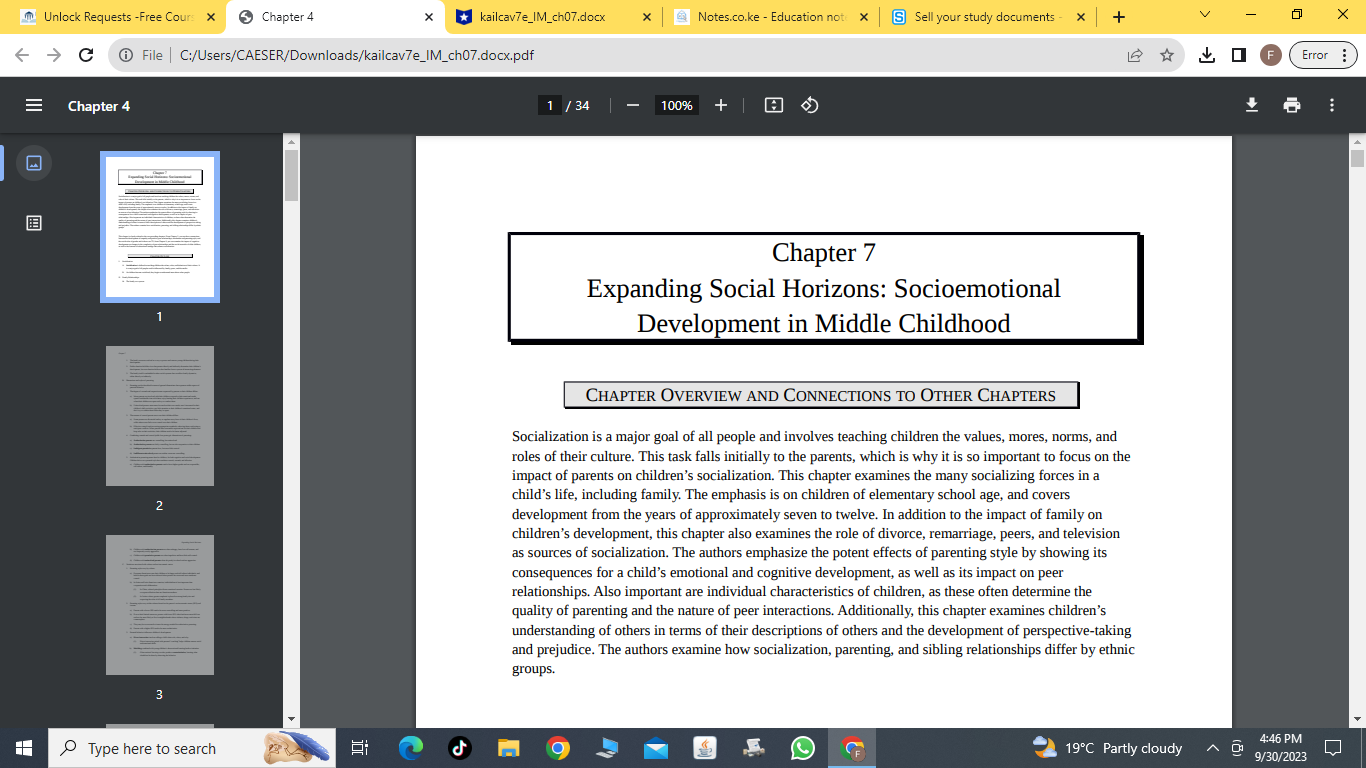
CHAPTER OVERVIEW AND CONNECTIONS TO OTHER CHAPTERS
Socialization is a major goal of all people and involves teaching children the values, mores, norms, and
roles of their culture. This task falls initially to the parents, which is why it is so important to focus on the
impact of parents on children’s socialization. This chapter examines the many socializing forces in a
child’s life, including family. The emphasis is on children of elementary school age, and covers
development from the years of approximately seven to twelve. In addition to the impact of family on
children’s development, this chapter also examines the role of divorce, remarriage, peers, and television
as sources of socialization. The authors emphasize the potent effects of parenting style by showing its
consequences for a child’s emotional and cognitive development, as well as its impact on peer
relationships. Also important are individual characteristics of children, as these often determine the
quality of parenting and the nature of peer interactions. Additionally, this chapter examines children’s
understanding of others in terms of their descriptions of others and the development of perspective-taking
and prejudice. The authors examine how socialization, parenting, and sibling relationships differ by ethnic
groups.
This chapter is closely related to the two preceding chapters. From Chapter 5, you can draw connections
between the development of empathy and positive peer relationships, attachment and parenting style, and
the social roles of gender and violence on TV; from Chapter 6, you can examine the impact of cognitive
development on changes in the complexity of peer relationships and the social networks of older children,
as well as the features of educational settings that enhance socialization.
Below is the document preview.

COMPANY LAW REVISION KIT
Trending!
The main purpose of this booklet is to help candidates preparing for the KASNEB
examination to make the best use of the last few weeks before the examination.
246 Pages
8918 Views
0 Downloads
1.63 MB
EES 100: MATHEMATICS FOR ECONOMISTS I
Trending!
Statistics which is a branch of mathematics is used by economists to transform
raw data from the real world into numerical generalizations. Such generalizations
are used by economists to construct a network of interlocking relationships which
enable them to draw conclusions about economic variables that are related to each
other only directly.
97 Pages
8544 Views
1 Downloads
901.83 KB
EET 200: MICROECONOMICS THEORY II
Trending!
The purpose of intermediate microeconomic theory is to provide an adequate exposition of the basic concepts and techniques of microeconomic analysis. The consumer and producer theory and the theory of markets will be treated mathematically and diagrammatically. Further, pure aspects of general equilibrium theory and welfare economics will be covered.
111 Pages
6670 Views
1 Downloads
1017.42 KB
EET 301: MACROECONOMIC THEORY III
Trending!
In this unit you will be introduced to the major macroeconomic theory paying
attention to their applicability in different settings of developing countries. The
general objectives of this unit may be summarized as follows: Explain the meaning of macroeconomic models. Detect strengths and weaknesses of macroeconomic models. Explain how macroeconomic models may be used for proper management of
an economy. Teach macroeconomics after your degree course; and Prepare yourself for more advance studies in economic theory.
115 Pages
6743 Views
0 Downloads
1.05 MB
FINANCIAL REPORTING
This paper is intended to equip the candidate with knowledge, skills and attitudes that will enable him/her to prepare financial statements for various entities and account for specialised transactions in both the public and private sectors.
371 Pages
1469 Views
0 Downloads
6.64 MB
FINANCIAL REPORTING REVISION KIT
Trending!
Distinguish between a finance lease and an operating lease indicating how they should
be treated in the financial statements as per International Accounting Standard (IAS) 17
'Leases'
371 Pages
8373 Views
1 Downloads
3.05 MB
ASC 423: SOCIOLOGY OF SCIENCE AND TECHNOLOGY
Trending!
This course introduces you to science and technology as social institutions and systems of knowledge production. We will take a sociological look at the process by which knowledge is collectively produced by communities and societies and how this knowledge is used.
36 Pages
7641 Views
0 Downloads
353.47 KB
DISORDER OF THE GALL BLADDER
Trending!
Disorders of the biliary tract affects significant portion of the world’s
population.
Less than 95% of biliary tract disease is due to cholelithiasis (gallstone)
Bile is secreted by liver and in between meals, it is stored in gall
bladder
68 Pages
7952 Views
0 Downloads
1.94 MB
DERMATOLOGY
The skin is composed of 3 layers
Epidermis
Dermis
Subcutaneous tissue/hypodermis
Epidermis has four layers from the innermost to outermost they are stratum
germinativum/basali, stratum granulosum, stratum lucidum and stratum corneum.
Dermis has two layers papillary and reticular it is also made up of blood and lymph
vessels, nerves, sweat and sebaceous glands.
Subcutaneous tissue/hypodermis its primarily adipose tissue
39 Pages
808 Views
2 Downloads
962.86 KB
DERMATOLOGY
The skin is the largest organ of the body:-SA 1.8m2,
16% of body wt.
Has 3 main layers- epidermis, dermis, subcutis
EPIDERMIS
Is a stratified squamous epithelium thickest at soles
and thinnest at glans penis.
Is a protective layer
Has 4 layers
175 Pages
511 Views
0 Downloads
3.62 MB