Expanding Social Horizons: Socioemotional Development in Middle Childhood
| Institution | Keiser University |
| Course | Pschology |
| Year | 4th Year |
| Semester | Unknown |
| Posted By | Faith Kagwi |
| File Type | |
| Pages | 34 Pages |
| File Size | 174.87 KB |
| Views | 5584 |
| Downloads | 0 |
| Price: |
Buy Now
 Buy via
whatsapp Buy via
whatsapp
|


Description
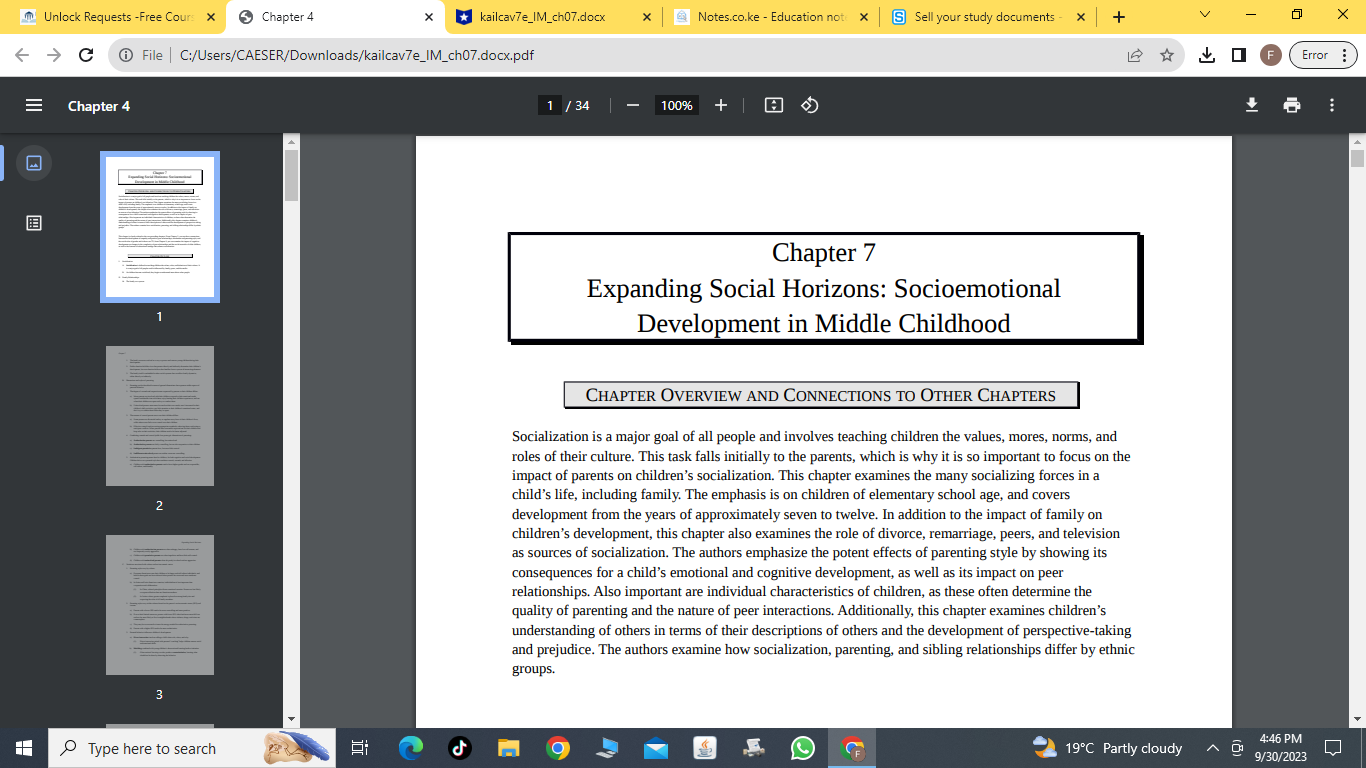
CHAPTER OVERVIEW AND CONNECTIONS TO OTHER CHAPTERS
Socialization is a major goal of all people and involves teaching children the values, mores, norms, and
roles of their culture. This task falls initially to the parents, which is why it is so important to focus on the
impact of parents on children’s socialization. This chapter examines the many socializing forces in a
child’s life, including family. The emphasis is on children of elementary school age, and covers
development from the years of approximately seven to twelve. In addition to the impact of family on
children’s development, this chapter also examines the role of divorce, remarriage, peers, and television
as sources of socialization. The authors emphasize the potent effects of parenting style by showing its
consequences for a child’s emotional and cognitive development, as well as its impact on peer
relationships. Also important are individual characteristics of children, as these often determine the
quality of parenting and the nature of peer interactions. Additionally, this chapter examines children’s
understanding of others in terms of their descriptions of others and the development of perspective-taking
and prejudice. The authors examine how socialization, parenting, and sibling relationships differ by ethnic
groups.
This chapter is closely related to the two preceding chapters. From Chapter 5, you can draw connections
between the development of empathy and positive peer relationships, attachment and parenting style, and
the social roles of gender and violence on TV; from Chapter 6, you can examine the impact of cognitive
development on changes in the complexity of peer relationships and the social networks of older children,
as well as the features of educational settings that enhance socialization.
Below is the document preview.

CHRONIC OBSTRUCTIVE PULMONARY DISEASES
Trending!
A condition in which;
• The lungs have become permanently altered .
• The airways in the lungs are constantly narrowed.
• Chronic inflammation creates difficulty breathing
43 Pages
7450 Views
0 Downloads
1.89 MB
CARDIOVASCULAR CONDITIONS
Trending!
Heart failure is defined as the pathophysiologic state in which impaired
cardiac function is unable to maintain an adequate circulation for the
metabolic needs of the tissues of the body.
• It may be acute or chronic.
• The term congestive heart failure (CHF) is used for the chronic form of heart
failure in which the patient has evidence of congestion of peripheral
circulation and of lungs.
56 Pages
7633 Views
0 Downloads
1.1 MB
COMMUNITY HEALTH III
This is the original data collected for a specific purpose
by or for an investigator. For example, an
epidemiologist may collect primary data by
interviewing people who became ill after eating at a
restaurant in order to identify which specific foods were
consumed.
Collecting primary data is expensive and time consuming, and it usually is undertaken only when
secondary data is not available
67 Pages
449 Views
1 Downloads
1.52 MB
KMTC DRAFT CERTIFICATE AND DIPLOMA COURSES GUIDE
Trending!
The purpose of this unit or module course guidelines is to equip the trainee or student with knowledge and skills to enable him or her know which unit or subject is being covered under certificate or diploma course
106 Pages
9198 Views
2 Downloads
1008.28 KB
KMTC BASIC COMMUNICATION SKILLS NOTES
Trending!
The purpose of this kmtc module or unit is to equip the trainee or student with knowledge and skills to enable him or her understand the concepts of communication skills in health as a whole
122 Pages
9909 Views
3 Downloads
1.57 MB
ASC 205: RURAL SOCIOLOGY
Trending!
This is the scientific study of people in group relations. Sociologists use scientific
methods in their research studies to develop a body of accurate and reliable knowledge about human relationships.
62 Pages
7391 Views
1 Downloads
889.65 KB
APH 103: INTRODUCTION TO ETHICS
Trending!
This module on introduction to ethics has been carefully developed to introduce you to the basic ethical concepts, theories and principles. Ethics being a philosophical discipline this module has employed the philosophical methods and tools of evaluation and analysis. The course therefore exposes you to philosophical thinking about morality.
91 Pages
9113 Views
2 Downloads
955.47 KB
AEN 200: ARTICULATORY PHONETICS PPT NOTES
Trending!
Fromkin, Rodman and Hyams (2009) define articulatory phonetics as the branch of phonetics that studies how the human vocal tract produces the sounds of language, while Crystal (2008) defines articulatory phonetics as "the study of the way speech sounds are made (articulated') by the avagal organs."
25 Pages
6862 Views
1 Downloads
897.89 KB
APS 106: INTRODUCTION TO LIFECYCLE DEVELOPMENT
Trending!
Development can be defined as systemic changes and continuities in the individual that occur between conception and death or from womb to tomb. The changes are systemic in that they are orderly, patterned and relatively enduring-not fleeting and unpredictable like mood swings. Involve continuities; ways in which we remain the same or continue to reflect our pasts.
110 Pages
6911 Views
0 Downloads
684.43 KB
APP 308: ADMINISTRATIVE LEADERSHIP
Trending!
Leadership is a process by which a person influences others to accomplish an
objective and directs the organization in a way that makes it more cohesive and coherent. Leadership is a process of social influence, which maximizes the efforts of others, towards the achievement of a goal.
86 Pages
7984 Views
1 Downloads
800.04 KB