Expanding Social Horizons: Socioemotional Development in Middle Childhood
| Institution | Keiser University |
| Course | Pschology |
| Year | 4th Year |
| Semester | Unknown |
| Posted By | Faith Kagwi |
| File Type | |
| Pages | 34 Pages |
| File Size | 174.87 KB |
| Views | 5599 |
| Downloads | 0 |
| Price: |
Buy Now
 Buy via
whatsapp Buy via
whatsapp
|


Description
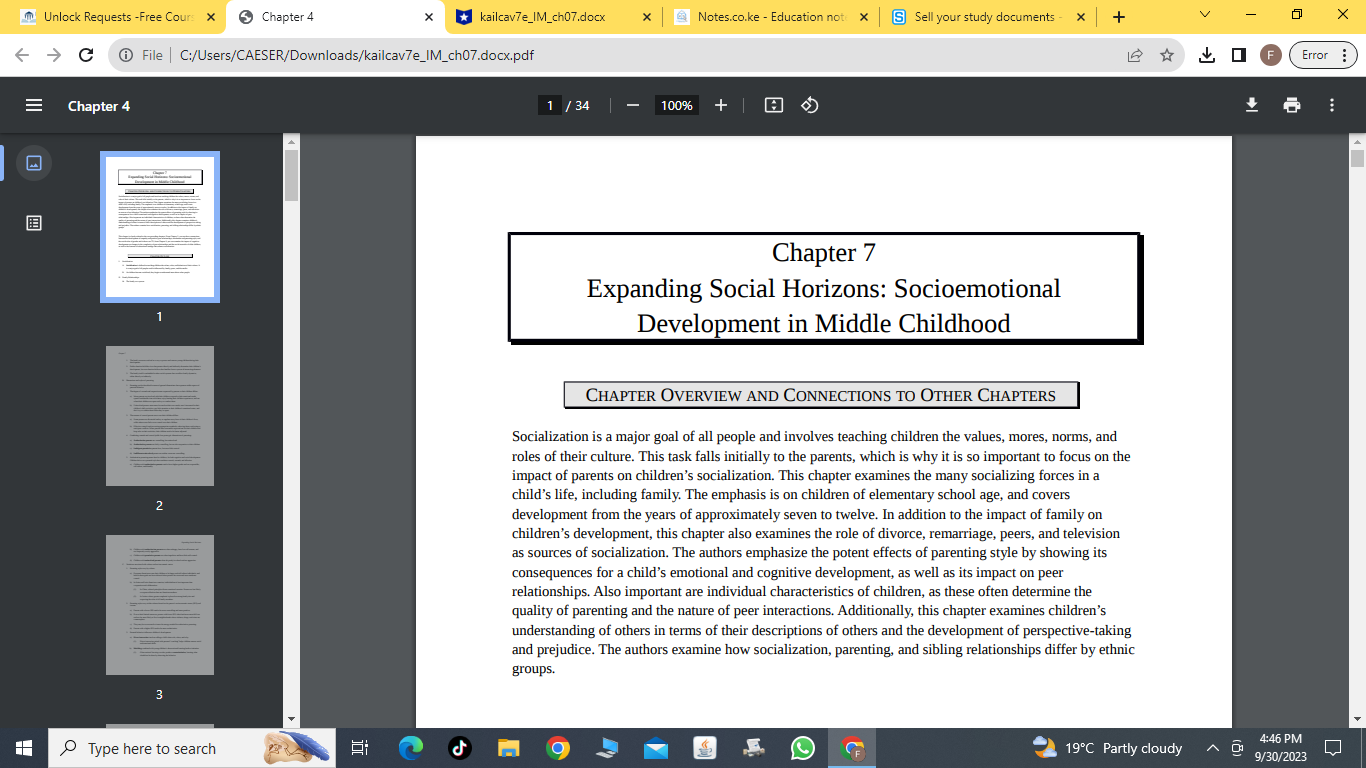
CHAPTER OVERVIEW AND CONNECTIONS TO OTHER CHAPTERS
Socialization is a major goal of all people and involves teaching children the values, mores, norms, and
roles of their culture. This task falls initially to the parents, which is why it is so important to focus on the
impact of parents on children’s socialization. This chapter examines the many socializing forces in a
child’s life, including family. The emphasis is on children of elementary school age, and covers
development from the years of approximately seven to twelve. In addition to the impact of family on
children’s development, this chapter also examines the role of divorce, remarriage, peers, and television
as sources of socialization. The authors emphasize the potent effects of parenting style by showing its
consequences for a child’s emotional and cognitive development, as well as its impact on peer
relationships. Also important are individual characteristics of children, as these often determine the
quality of parenting and the nature of peer interactions. Additionally, this chapter examines children’s
understanding of others in terms of their descriptions of others and the development of perspective-taking
and prejudice. The authors examine how socialization, parenting, and sibling relationships differ by ethnic
groups.
This chapter is closely related to the two preceding chapters. From Chapter 5, you can draw connections
between the development of empathy and positive peer relationships, attachment and parenting style, and
the social roles of gender and violence on TV; from Chapter 6, you can examine the impact of cognitive
development on changes in the complexity of peer relationships and the social networks of older children,
as well as the features of educational settings that enhance socialization.
Below is the document preview.

AMS 308 Lecture 5: THE LATIN SQUARE DESIGN
Trending!
Suppose that an experimenter is studying the effects of five different formulations of
a rocket propellant used in aircrew escape systems on the observed burning rate.
Each formulation is mixed from a batch of raw material that is only large enough for
five formulations to be tested.
6 Pages
6298 Views
2 Downloads
690.8 KB
AMS 309 Lecture 1: Probability Generating Functions
Trending!
A mathematical model which specifies complete probability distribution of the number of individuals in a given system at each point of time is a stochastic model.
9 Pages
8840 Views
3 Downloads
452.97 KB
AMS 309 Lecture 2: Discrete Branching Process
Trending!
Suppose that one particle can produce a random number of k new particles. Each of the
new particles produces another random number of new particles. We assume that the
particles act independently of each other and that every particle has a probability pk of
producing k new particles (for k = 0, 1, 2, , . . ).
7 Pages
8265 Views
2 Downloads
408.88 KB
AMS 309 Lecture 3: Markov Chains
Trending!
We consider a special case where the outcome of any trial depends on the outcome of the directly preceding trial, and only on it. A stochastic process with this property is referred to as a Markov Chain (or a Markov process).
12 Pages
6062 Views
2 Downloads
503.64 KB
AMS 309 Lecture 4: Absorbing Markov Chains and Random Walk ModelS
Trending!
An absorbing Markov Chain contains only absorbing and transient states. If the number of states is finite, a Markov process starting from any transient state will eventually end in one of the absorbing states. Suppose that there are s absorbing states and t transient states so that the transition matrix P is order (s + t).
10 Pages
7771 Views
2 Downloads
463.66 KB
AMS 309 Lecture 5: Birth and Death Processes
Trending!
In this Chapter, we develop probability models for some special cases of birth-and –death process involving the population size within a given system at time t.
The probability generating function can be used to analyze the process in the case where the actual probability distribution cannot be obtained. We also obtain deterministic models corresponding to the given probability models.
14 Pages
6204 Views
2 Downloads
483.81 KB
ASC 407: SOCIOLOGY OF WORK & INDUSTRY
Trending!
This course will provide you with an introduction to the sociology of work. It is designed to provide you with a broad overview while giving emphasis to specific topics in detail. It is beyond the scope of this unit to cover the field of work and industry in entirety.
111 Pages
7886 Views
1 Downloads
1.57 MB
AUDITING AND ASSURANCE REVISION KIT
Given adequate and focussed preparation, this kit should be useful in enabling any student preparing for examinations in Auditing and related courses to pass with good grades in the exams.
798 Pages
1566 Views
0 Downloads
4.13 MB
EDUC120: PSYCHOLOGY
Trending!
Initially psychology was a branch of philosophy that explained human nature from metaphysical (unscientific)
perspective. For example, with this definition a parent would say that his child is not doing well in class
because he is being cursed. Yet a more realistic explanation could be from a variety of sources such as social
problems and poor teaching methods. The word psychology was derived from two Greek words (1 ) psyche -
mind, soul, spirit and (2) logos - the study of-----. Therefore, psychology was initially defined as "The study of
the mind
76 Pages
7726 Views
0 Downloads
1.71 MB
EDUC 121: CURRICULUM DEVELOPMENT
Trending!
Education promotes international consciousness and foster
positive attitudes towards other nations
Kenya is part of the interdependent network of
diverse peoples and nations. Education should
empower the learner to respect, appreciate and
participate in the opportunities within the international community. Education should also enable the learner to operate within the international community with full knowledge of the obligations, responsibilities, rights and benefits that this membership entails
34 Pages
6577 Views
2 Downloads
1.51 MB