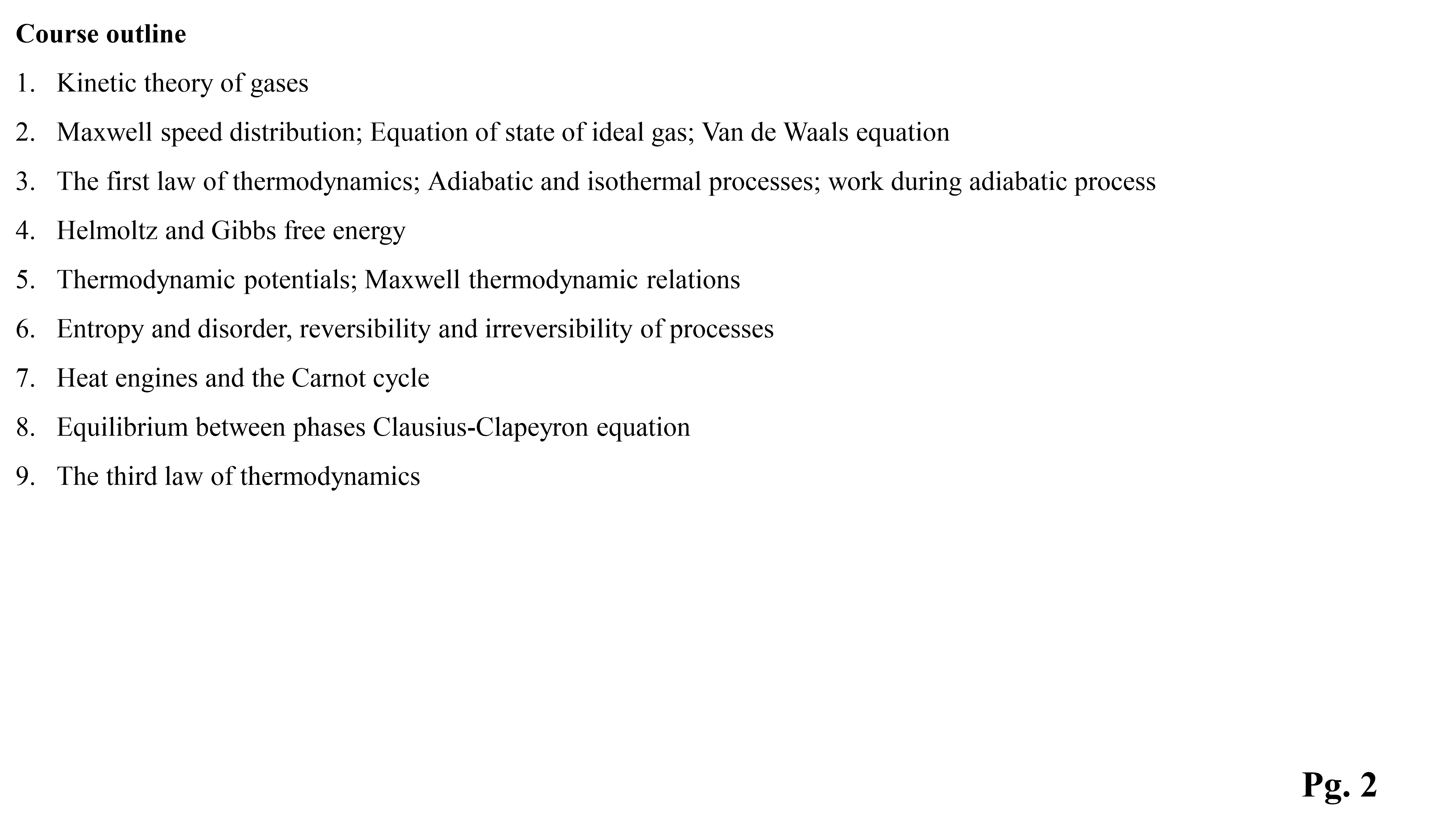
SPH 302 LESSON 1: THERMODYNAMICS
| Institution | TOM MBOYA UNIVERSITY |
| Course | EDUCATION |
| Year | 3rd Year |
| Semester | Unknown |
| Posted By | Brian Mike |
| File Type | |
| Pages | 11 Pages |
| File Size | 311.84 KB |
| Views | 7862 |
| Downloads | 1 |
| Price: |
Buy Now
 Buy via
whatsapp Buy via
whatsapp
|


Description
Applications of the kinetic theory of gases are countless. Automobile engineers are concerned with the combustion of vaporized fuel (a gas) in the automobile engines. Food engineers are concerned with the production rate of the fermentation gas that causes bread to rise as it bakes. Beverage engineers are concerned with how gas can produce the head in a glass of beer or shoot a cork from a champagne bottle. Medical engineers and physiologists are concerned with calculating how long a scuba diver must pause during ascent to eliminate nitrogen gas from the bloodstream (to avoid the bends).
Below is the document preview.

Elimination Reactions
Trending!
An elimination is the loss of two atoms or groups from a molecule, which will typically result in the formation of a new bond.
8 Pages
7468 Views
0 Downloads
166.38 KB
INTRODUCTION TO ORGANIC CHEMISTRY MECHANISMS
Trending!
Lewis Structures
A Lewis structure shows what atoms are connected to each other, and it shows where the electrons in the molecule reside. Single bonds between two atoms are represented with a single line, signifying two shared electrons; double bonds are represented with a double line, signifying four shared electrons; and triple bonds are represented with a triple line, signifying six shared. Nonbonding electrons are indicated with dots on the atoms on which they reside.
41 Pages
9696 Views
0 Downloads
1.62 MB
Nanoscience, Nanotechnology, and Chemistry
Trending!
Nanoscience is the emerging science of objects that
are intermediate in size between the largest molecules and
the smallest structures that can be fabricated by current
photolithography; that is, the science of objects with smallest dimensions ranging from a few nanometers to less than
100 nanometers.[1–3] In chemistry, this range of sizes has historically been associated with colloids, micelles, polymer
molecules, phase-separated regions in block copolymers,
and similar structures—typically, very large molecules, or
aggregates of many molecules. More recently, structures
such as buckytubes, silicon nanorods, and compound semi conductor quantum dots have emerged as particularly interesting classes of nanostructures. In physics and electrical engineering, nanoscience is most often associated with quantum behavior, and the behavior of electrons and photons in
nanoscale structures. Biology and biochemistry also have a
deep interest in nanostructures as components of the cell;
many of the most interesting structures in biology—from
DNA and viruses to subcellular organelles and gap junctions—can be considered as nanostructures.
8 Pages
8754 Views
1 Downloads
556 KB
Reactions of Alkyl halides
Trending!
In this type of reaction, a nucleophile reacts with haloalkane (the substrate) having a
partial positive charge on the carbon atom bonded to halogen. A substitution reaction takes place and halogen atom, called leaving group departs as halide ion. Since the substitution reaction is initiated by a nucleophile, it is called nucleophilic substitution reaction
122 Pages
6279 Views
0 Downloads
3.2 MB
Substitution and Elimination Electron Flow Pathway
Trending!
Path Limitations
There are three requirements for the S N 2 reaction.
In order to be pushed out, the leaving group must be at least fair, usually good. The nucleophile also must be reactive enough to push out the leaving group.
Finally, the back side of the tetrahedral carbon attacked must be
accessible to the nucleophile and not blocked by other groups.
5 Pages
7325 Views
0 Downloads
352.61 KB
The SN2 reaction
Trending!
The hydroxide ion is a good nucleophile since the oxygen atom has a negative charge and a pair of unshared electrons.
The carbon atom is electrophilic since it is bound to a (more electronegative)
halogen, which pulls electron density away from the carbon, thus polarizing the
bond with carbon bearing partial positive charge and the halogen bearing partial negative charge.
The nucleophile is attracted to the electrophile by electrostatic charges.
The nucleophile attacks the electrophilic carbon through donation of 2 electrons. Carbon can only have a maximum of 8 valence electrons, so as the carbon nucleophile bond is forming, then the carbon-leaving group bond must be breaking. Iodide is the leaving group since it leaves with the pair of electrons that once bound it to carbon.
13 Pages
6772 Views
0 Downloads
190.14 KB
AMAZING SCORE C.R.E PAPER 2
Trending!
Grab a copy of the AMAZING SCORE C.R.E PAPER 2 quick revision booklet that covers all the examinable areas in 313/2. Download your copy today!
193 Pages
10416 Views
3 Downloads
6.32 MB
KASSU JET JUL/AUG MOCK 2024; Geography PP1 & PP2 Q&A
Trending!
Download a copy of the KASSU JET JUL/AUG MOCK 2024; Geography PP1 & PP2 Question Papers with well coordinated Marking Schemes attached. This is good revision material for your upcoming exams.
37 Pages
9717 Views
2 Downloads
1.31 MB
ATP 103: LEGAL WRITING AND DRAFTING
Trending!
The purpose of the manual is to guide Counsel on general methods of legislative drafting. Further, it is intended to serve as a ready reference and guide to legislative drafting in addition to published works on the subject. The manual sets out uniform legislative drafting standards and principles to be applied by Counsel in the National Assembly.
96 Pages
5903 Views
5 Downloads
1.63 MB
MASENO SCHOOL JUL/AUG MOCK 2024; Business Studies PP1 & PP2 Q&A
Trending!
Download a copy of the MASENO SCHOOL JUL/AUG MOCK 2024; Business Studies PP1 & PP2 Question Papers with well coordinated Marking Schemes attached. This is good revision material for your upcoming exams.
39 Pages
10233 Views
2 Downloads
3.5 MB