KMTC: TONSILITIS PEADIATRICS LECTURE NOTES
| Institution | Kenya Medical Training College |
| Course | DIPLOMA/CERTIFICATE... |
| Year | 2nd Year |
| Semester | Unknown |
| Posted By | Theatre Nurse mishi |
| File Type | pptx |
| Pages | |
| File Size | 1.06 MB |
| Views | 2280 |
| Downloads | 0 |
| Price: |
Buy Now
 Buy via
whatsapp Buy via
whatsapp
|


Description
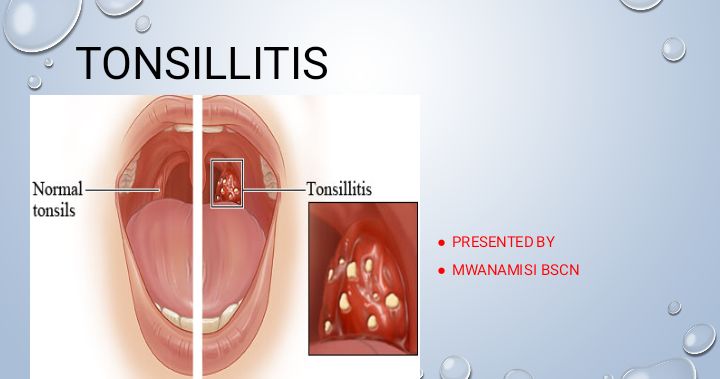
Tonsils are protective (lymph) gland that are situated on both sides in the throat.
Tonsils constitute an important part of the body’s immune system and are vital defense organ.
They protect the body from bacteria and viruses by fighting these as soon as they enter the body via the oral / nasal cavity.
Most cases bacterial tonsillitis are caused by group A beta- hemolytic streptococcus pyogenes (GABHS).
Below is the document preview.

Introduction to nutrition surveillance
Trending!
Surveillance: It refers to the act of carefully watching someone or something
especially in order to prevent or detect an occurrence of a given situation. It can
also be defined as a continuous observation of a place, person, group, or ongoing
activity in order to gather information:
100 Pages
3655 Views
0 Downloads
1.8 MB
Nutrition Care Process
Trending!
Nutrition care process module is designed to equip the learner with knowledge, skills and attitude to enable the learner implement nutrition care process in every nutrition intervention. The prerequisite modules include; Principles of human nutrition, Nutrition
intervention in HIV/AIDS and Communicable & non communicable diseases, Management of malnutrition, Nutrition surveillance, Diet therapy 1 and Nutrition in the Lifespan
The module takes 30 contact hours: 13 hours for theory and 17 hours for practicals. Learners undertaking this module will have both theory and practical assessments. The formative assessment will be in the form of
continuous assessment tests, assignments, clinical and field assessments and
end of semester examination whereas summative assessment will be done in
form of final qualifying examination.
49 Pages
3421 Views
0 Downloads
1.26 MB
Communicable & Non-Communicable Diseases
Trending!
Communicable and non-communicable diseases module is designed to equip the learner with knowledge, skills and attitude to enable them manage and counsel the patients on communicable and non-communicable disease. The prerequisite modules include; Human anatomy and physiology, HIV & AIDS, Principles of human nutrition, Introduction to Microbiology . The module takes 60 contact hours: 26 hours for theory and 34 hours for practicals. Learners undertaking this module will have both theory and practical assessments. The formative assessment will be in the form of continuous assessment tests, assignments, clinical and field assessments and promotional examination whereas summative assessment will be done in form of final qualifying examination.
113 Pages
3356 Views
1 Downloads
980.05 KB
FOOD SAFETY AND HYGIENE
Trending!
Safety : overall quality of food fit for
consumption.
• Sanitation : a state of being clean and conducive
to health.
• Cleanliness :is the absence of visible dirt and is
not necessarily sanitized.
• Microorganisms :organism of microscopic or
submicroscopic size. (bacterium , protozoan).
• Food borne illness: A disease caused by
consuming contaminated food or drink. e.g
botulism, salmonellosis
138 Pages
3645 Views
0 Downloads
2.43 MB
NUTRITION EDUCATION & COUNSELLING
Trending!
What is nutrition counselling?
Nutrition counselling is a two-way interaction through which a client and a trained counsellor interpret the results of nutrition assessment, identify individual nutrition needs and goals, discuss ways to meet those goals, and agree on next steps. Nutrition counselling aims to help clients understand important information about their health and focuses on practical actions to address nutrition needs, as well as the benefits of behavior change. Nutrition counsellors may be nurses or other facility based providers or community health workers or volunteers.
50 Pages
3789 Views
0 Downloads
1.43 MB
INTRODUCTION TO HUMAN ANATOMY AND PHYSIOLOGY
• Understand the terms used for describing the structure and function of different
regions of gross anatomy.
• Describe the structure and functions of human cell.
• Describe human systemic anatomy.
• Describe the anatomy of the skin.
• Describe human physiology
16 Pages
797 Views
0 Downloads
466.19 KB
INTRODUCTION TO DIET THERAPY
Trending!
This document outlines key concepts in diet therapy like maintaining normal nutrition, correcting nutritional deficiency, how to treat and manage disease and restore health, prevent or delay complications of a disorder and alleviate symptoms of a disease.
439 Pages
3500 Views
1 Downloads
2.93 MB
MANAGEMENT OF MALNUTRITION
Concepts in management of malnutrition; Overview malnutrition in Kenya, national nutrition goals, global nutrition goals.
85 Pages
663 Views
1 Downloads
2.15 MB
INTRODUCTION TO NUTRITION SURVEILANCE
Trending!
Enable the learner to carry out nutrition assessment and apply the knowledge, skills and attitudes gained in nutrition surveillance
49 Pages
3518 Views
0 Downloads
319.94 KB
PHARMACOKINETICS
Trending!
This document gives a clear review on membrane transport absorption and distribution of drugs.
14 Pages
3692 Views
0 Downloads
843.65 KB